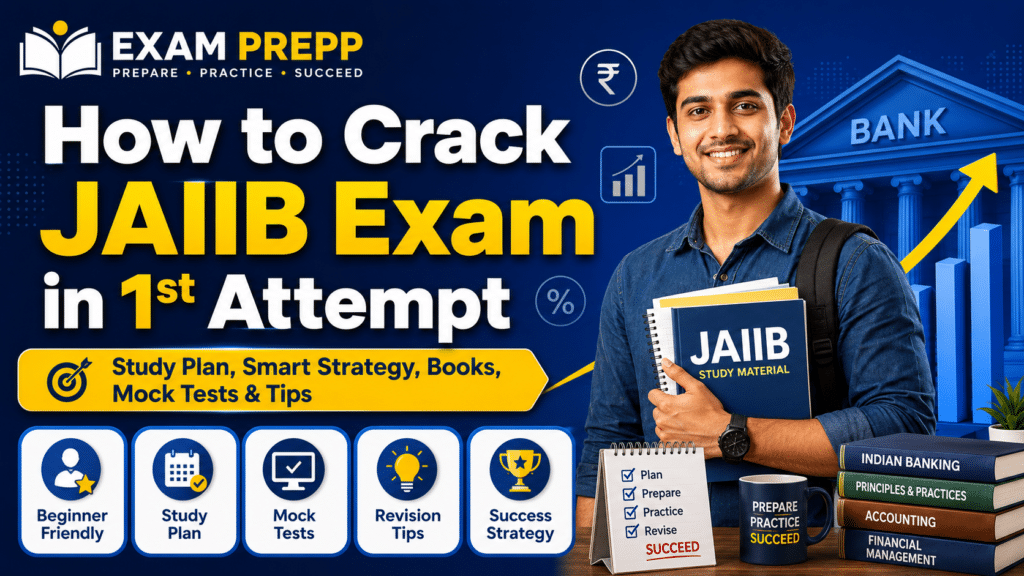
Do not wait for the exam notification to buy bulky study materials. Start with a structured target of spending just 45-60 minutes daily. Consistency on tools like the ExamPrepp App will easily put you ahead of 90% of candidates. (Note: Non-bankers preparing for the same syllabus should explore the DBF Exam instead!)
To win the battle, you must know the battlefield. As per the revised syllabus
Paper No.
Paper Name
Total Questions
Total Marks
Duration
Paper I
Indian Economy & Indian Financial System (IE&IFS)
100 MCQs
100 Marks
2 Hours
Paper II
Principles & Practices of Banking (PPB)
100 MCQs
100 Marks
2 Hours
Paper III
Accounting & Financial Management for Bankers (AFM)
100 MCQs
100 Marks
2 Hours
Paper IV
Retail Banking & Wealth Management (RBWM)
100 MCQs
100 Marks
2 Hours
🚨 Important Passing Criteria Rules
You need a minimum of 50 marks out of 100 in each paper to pass. However, if you get at least 45 marks in each individual paper and score an aggregate of 50% overall (200 out of 400 total) in your very first attempt, you will still be declared successful!
1. Indian Economy & Indian Financial System (IE&IFS)
This paper bridges general macroeconomics with operational financial architectures. It is highly concept-oriented and theoretical.
Focus Areas: Focus extensively on economic concepts related to banking: National Income, GDP, Monetary Policy (Repo Rate, CRR, SLR), Fiscal Policy, and the role of regulators like RBI, SEBI, IRDAI, and PFRDA.
Winning Strategy: Read Module A and Module B first. Understand economic indicators and planning structures (NITI Aayog). Do not try to memorize everything; instead, focus on how macro-decisions directly impact bank deposit liquidity.
2. Principles & Practices of Banking (PPB)
This is often considered the most scoring paper for retail branch bankers because most of the questions align with your day-to-day operations.
Winning Strategy: Pay special attention to Module D (Ethics in Banks). It is relatively short but accounts for roughly 15% of the marks. Scoring high in ethics is the easiest way to buffer your overall PPB score.
3. Accounting & Financial Management for Bankers (AFM)
This paper is traditionally feared by non-commerce graduates. AFM requires a rigorous mixture of theoretical comprehension and numerical practice.
Focus Areas: Balance Sheet Equation, Depreciation methods (Straight Line & WDV), Ratio Analysis (highly crucial), Capital Budgeting (NPV, IRR), and Yield to Maturity (YTM) for bonds.
Winning Strategy: Do not avoid the formulas. Practice basic ledger posting and trial balance rules early. For simple, concept-by-concept breakdowns, check out the ExamPrepp JAIIB Note Series. Knowing how to solve even 5 to 6 common numerical models will instantly secure your passing score.
4. Retail Banking & Wealth Management (RBWM)
This is a practical, highly interactive subject introduced to align candidates with the modern, retail-focused banking market.
Focus Areas: Retail credit products (Home loans, Auto loans, Personal loans), Credit scoring models, branch profitability metrics, and wealth management (Mutual funds, insurance products, asset allocation).
Winning Strategy: Draw upon your direct experience with cross-selling products in your branch. Learn the marketing mix, customer segmentation, and CRM techniques, as these yield easy-to-grab marks.
📚 Essential JAIIB Reference Study Materials
Prepare with comprehensive study notes, curated exam guides, and physical books directly targeted to save you hundreds of hours of manual research.
To pass JAIIB on your first go, structure your preparation into three distinct, manageable phases over 60 days:
Phase 1: Concept Mastery (Days 1 to 30)
Dedicate this phase entirely to module-wise learning. Allocate 1 hour daily on weekdays. Start with AFM (since it needs conceptual calculations) and IE&IFS. Read core topics and clear basic terminologies.
Phase 2: Question Practice (Days 31 to 45)
Solve chapter-wise MCQs and test your pattern recognition using JAIIB Previous Year Papers. You can also evaluate your topic mastery with Free Quizzes. Keep a formula diary handy for AFM and macroeconomic formulas from Paper I.
Spend the last two weeks taking timed full-length mock tests. This builds endurance to solve 100 questions in 120 minutes without losing focus. Make sure to review explanations for questions you answered incorrectly.
Highly Effective Practical Exam Strategies
The “No Negative Marking” Hack
Since the IIBF has currently kept the negative marking on hold, you must attempt all 100 questions. If you encounter a complex case study or numerical in PPB/AFM that you don’t know, flag it for later, solve the theoretical portions first, and return to make an educated guess by eliminating the two most unlikely options.
Leverage Daily Work Experience
You work in a living laboratory of banking! When reviewing topics like clearing, bank guarantees, letters of credit, mortgage creation, and collateral checks, relate them directly to cases handled at your branch. This contextual memory will stay with you far better than memorized text.
Focus on the 50/50 Concept Strategy
Don’t aim for 100% perfection. Aim for 60% high-yield clarity. Getting 100 out of 100 gets you the exact same credit as getting 55 out of 100. Structure your daily revision around high-weightage modules first.
🎯 Looking Ahead: What’s Next?
Clearing JAIIB is only the first step. Once you pass, you become eligible for the next-level promotion and increment benchmark—the prestigious CAIIB exam. Aligning your strategies early prepares you for a highly accelerated career growth path!
Unlock our premium suite of simulated full-length mock tests with the Prime Test Series, high-yield PDF summaries, and concept quizzes created explicitly for working bankers. Gain comprehensive platform access with our premium Test Pass.
Yes. With a highly structured study plan of just 1.5 to 2 hours daily, and consistent evaluation using premium mock tests, clearing JAIIB in one go is very achievable, even with busy banking schedules.
What are the passing marks for the JAIIB exam?
You need to score at least 50 out of 100 in each paper. However, if you get at least 45 marks in each individual paper and score an aggregate of 50% (200 out of 400 total across all four papers) in a single attempt, you pass the entire exam.
Is there negative marking in the JAIIB exam?
No, there is currently no negative marking in the JAIIB exam, making it beneficial for you to answer every single question on the paper.
Which is the toughest paper in JAIIB?
Generally, Paper 3: Accounting & Financial Management for Bankers (AFM) is considered the most difficult, especially for bankers coming from non-commerce academic backgrounds. We recommend dedicating extra time to AFM’s practical numerical questions early on in your schedule.
Welcome to Exam Prepp, your trusted destination for structured, exam-oriented preparation for DBF, JAIIB, CAIIB, RBI Grade B and other banking exams. We design our resources to help you study with better clarity, smarter revision and consistent practice.