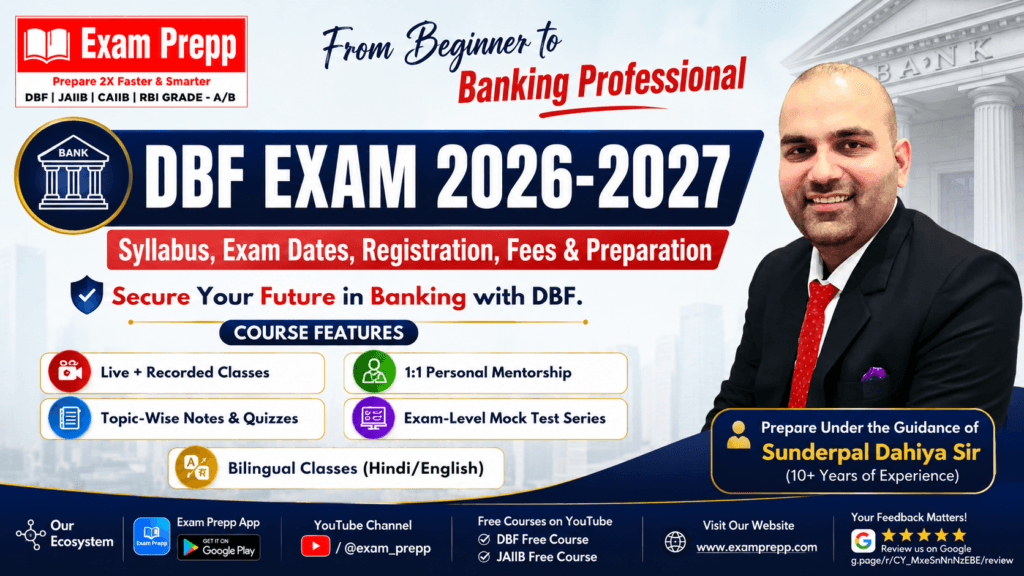
DBF Exam 2026-2027: Syllabus, Exam Dates, Registration, Fees & Preparation
Secure Your Future in Banking with DBF
The DBF Exam 2026-27, officially known as the Diploma in Banking and Finance examination, is conducted by IIBF for eligible non-members interested in banking and finance. Whether you’re a student, graduate, or banking aspirant, the IIBF Diploma in Banking & Finance (DBF) is your first step toward building a strong foundation in the banking world.
Prepare under the expert mentorship of Sunderpal Dahiya Sir with bilingual classes, chapter-wise notes, practice MCQs, mock tests, and a structured study plan designed to clear your DBF Exam 2026-27 with high confidence.
Start Your DBF Preparation Today →
Course Features
- Live + Recorded Classes
- 1:1 Personal Mentorship
- Topic-Wise Notes & Quizzes
- Exam-Level Mock Test Series
- Bilingual Classes (Hindi/English)
Explore DBF Preparation
Choose your paper, review the syllabus, practise questions, and select the study format that fits you. These links take you to existing Exam Prepp resources.
Choose a paper
Start here and keep learning
Read the DBF 2027 guide, then see the DBF to JAIIB conversion and credit-transfer guide. For personal study guidance, contact Sunderpal Dahiya Sir through the options on this page.
What is DBF?
DBF stands for Diploma in Banking & Finance. It is a highly respected professional certification program conducted by the Indian Institute of Banking & Finance (IIBF) specifically for non-bankers.
This diploma serves as a gateway to the banking sector. The syllabus is completely identical to the JAIIB exam, ensuring that candidates are fully trained in accounting, financial management, economics, and standard banking operations even before securing their first bank job.
Who is Eligible?
-
Target Audience: Fresh graduates, final-year college students, and financial job seekers who are not currently working in a bank.
-
Membership Status: Open only to “Non-Members” of the IIBF. (Ordinary bank employees must register for the JAIIB instead).
-
Education: Must have passed the 12th standard (or equivalent) in any discipline.
DBF vs JAIIB Decision Portal & Fee Estimator
Use our dynamic tools to map your banking career pathway and plan your registration budget accurately.
Career Path Decider
Map your professional eligibility route instantly based on industry regulations
Please complete the parameters on the left to activate your customized career path mapping.
Recommended Pathway
DBF/ JAIIB Exam Fee Estimator
Instantly compute base fee, late penalties, and mandatory 18% GST
Estimated Statement
Revised Passing Criteria Analyzer
Determine eligibility according to individual and aggregate rules
The revised scoring rules are parsed mathematically as follows:
- Subject-wise Clear: $P_i \ge 50$ for every paper $i \in \{1, 2, 3, 4\}$.
- Aggregate Single-Attempt Clear: $P_i \ge 45$ for every paper and $\sum_{i=1}^{4} P_i \ge 200$.
Average Score: 50.0%
PASSED (Aggregate Single-Attempt)
Awesome! Every subject scored at least 45, and your cumulative score is >= 200. This is a declared pass if all 4 papers are cleared together in a single attempt.
Who Should Pursue the DBF Exam?
The Diploma in Banking & Finance is a highly prized industry-entry credential specifically engineered for the following profiles:
12th pass students from any discipline seeking early professional credentials.
Undergraduate / Graduate students from any stream seeking high-value specialisations.
Aspirants looking to build an active, lifetime career in banking and finance.
Candidates preparing for competitive Banking Exams (such as SBI PO, IBPS PO, or Clerk operations).
Aspirants preparing for Insurance Industry Exams (LIC, NICL, NIACL, GIC, etc.).
Aspirants targeting Regulatory Body positions (like RBI Grade B, NABARD, SEBI, SIDBI, PFRDA).
Students whose final university exams or selections are delayed but want to save time.
Candidates seeking to boost confidence for challenging panel banking interviews.
Freshers looking to gain an immediate edge in interview rounds with professional credentials.
Learners aiming to acquire deeper theoretical and operational banking knowledge.
Candidates targeting recruitment drives of leading Private Sector Banks or NBFCs.
Candidates wanting a guaranteed salary increment from their first month of joining.
Non-commerce stream graduates seeking to smoothly transition into financial services.
Cooperative bank, payment bank, or SFB staff looking to qualify for IBA-level benefits.
Those working in banks or other financial institutions via 3rd-party outsourcing agencies or without official payroll, seeking a solid path to permanent direct roles.
Diploma in Banking & Finance Details
Core qualification insights, professional standards, and employment connectivity portal highlights.
About the Diploma
1. To meet this demand and ensure a steady pipeline of industry-ready professionals, IIBF has designed the Diploma in Banking & Finance as a professional qualification for aspirants seeking a career in banking and finance.
2. Such professionals can be placed directly at various desks and jobs with minimal training intervention at the bank level.
3. Successful candidates will gain a competitive edge in employment opportunities with banks and financial institutions.
3. The Course Provides:
- a. Comprehensive Knowledge Inputs
- b. Exposure to Operational Processes
- c. Understanding of the Modern Banking Environment
5. IIBF Resume Database Accessibility
Additionally, IIBF will host the resumes of successful candidates on its official website, accessible to its member institutions, including:
Salient Features
- 1. Makes candidates job-ready from day one.
- 2. Backed by IIBF’s high professional standards.
- 3. Affordable course, with options for e-learning and virtual classes.
- 4. Valued by employers for hiring and talent scouting.
- 5. Helps banks reduce post-recruitment training time.
- 6. Recognised as equivalent to JAIIB qualification.
- 7. Provides knowledge of banking, finance, technology, and customer service.
- 8. Designed with high academic rigor and specially prepared courseware.
- 9. Based on quality course material with theory + practical insights.
Who Conducts the DBF Exam?
Get to know the official governing body responsible for professionalizing India’s banking sector.
IIBF Profile
Indian Institute of Banking & Finance
About the Indian Institute of Banking & Finance
The Indian Institute of Banking & Finance (IIBF) is a professional body of banks, financial institutions, and their employees in India. Established in 1928 as the Indian Institute of Bankers, it is registered under Section 25 of the Indian Companies Act, 1913. IIBF is an ISO 21001:2018 certified organization for Educational Organizations Management Systems (EOMS).
IIBF is the largest institute of its kind in the world, catering to over 10 Lakh ordinary and institutional members. It is governed by a distinguished Council comprising banking and academic leaders from PSU banks, private banks, and senior representatives from the Reserve Bank of India (RBI).
Core Responsibility of IIBF
To develop professionally qualified and competent banking and finance professionals through strict educational, certification, training, and professional development programs. The DBF exam is one of its highly recognized flagship certifications.
IIBF Examinations & Courses at a Glance
An overview of the complete professional educational framework provided by the IIBF.
Diplomas
- DTIRM
- International Banking
- Banking Technology
- Retail Banking
- Wealth Management
- Urban Coop Banking
Certificates
Blended Courses
(Exam + Tng)
- Compliance
- Bank Trainer
- Treasury*
- Credit*
- Risk in Financial Services*
- Accounting & Audit*
* Capacity Building Courses
Management Programs
- MBA (IGNOU)
- AMP
Industry Recognition: About IBA
About Indian Banks’ Association (IBA)
- The Indian Banks’ Association (IBA) has approved the Diploma in Banking & Finance conducted by IIBF as a desirable qualification (alongside other prescribed entry-level qualifications) for recruitment in banks.
- The Indian Banks’ Association (IBA) was formed on September 26, 1946 in Mumbai with 22 banks and financial institutions as its founding members.
- Today, the membership has grown significantly, and the Association now has a total of 235 member banks and institutions (Ordinary Members: 136, Associate Members: 99).
- IBA acts as the representative body of the banking industry, working with the Government, RBI, and other regulators to promote and strengthen Indian banking.
Backed by India’s Apex Banking Authority
Providing unparalleled industry validation for your DBF credential during recruitment.
What is IIBF Non-Member Registration?
Registration for the DBF examination requires active Non-Member Registration of the IIBF. Follow our step-by-step registration portal tutorial.
Understanding IIBF Non-Member Profile
Since DBF is built specifically for candidates not currently working in the financial sector, they cannot purchase standard Ordinary Memberships. Instead, they must register on the IIBF portal under the Non-Member profile.
Prerequisites for Non-Member Registration
You must keep your Aadhaar Card, Passport, or PAN card ready for KYC verification, along with passport-size digital photos and scans of your signature within official IIBF file specifications.
Non-Member Registration Steps
1 Visit the IIBF portal at iibf.org.in and click on “Non-Members” under the Apply Online menu.
2 Complete the online non-member registration form, entering detailed educational qualifications and identity proofs.
3 Upload high-resolution scans of your photograph, signature, and government ID card within the specified file dimensions.
4 Systematically complete the verification of your mobile number and email address via OTP.
5 Upon approval, your unique Registration ID will be generated and emailed to you, allowing you to log in and book the DBF exam.
Steps to Apply Online for the IIBF DBF Exam
Follow this structured, official application process to successfully register for the next DBF examination cycle.
Portal Login
Go to the IIBF homepage and log in using your newly generated Non-Member Registration ID and password.
Select DBF Exam
Select “Diploma in Banking & Finance (DBF)” from the active exam lists and read through the guidelines carefully.
Fill Out Details
Complete the exam application fields, choose your preferred medium of exam (Hindi or English), and enter your educational profile.
Book Slot & Center Venue
Choose your desired examination city, center venue, dates, and preferred batch shifts based on real-time availability.
Online Payment
Submit the ₹3,500/- base registration fee online via debit card, credit card, net banking, or UPI to confirm your booking.
Key Registration Protocols
- Seat allocations are executed on a First Come First Served basis. Apply in the first week to secure your nearest venue and shift.
- Verify your photo and signature specs strictly. If they do not match, IIBF can cancel your slot at any point prior to the exam.
- Keep your payment receipt and admit card printout secure. Admit cards are normally available for download 10 days before the exam.
Most Important Chapters & Subject-Wise Weightage
Study smarter, not harder. Sunderpal Dahiya Sir’s module-by-module layout of high-weightage topics to easily clear your exam.
Paper 1: IE & IFS
Vast SyllabusModule A: Indian Economic Architecture (Expected: 25-30 Marks)
Focus areas: Economic Planning in India, NITI Aayog, Priority Sector & MSME lending parameters, and Infrastructure development.
Module C: Indian Financial Architecture (Expected: 30-35 Marks)
Focus areas: Indian Banking Structure, Regulatory frameworks (RBI Act 1934 & BR Act 1949), and Non-Banking Financial Companies (NBFCs).
*Pro-Tip: Summarized tables of financial regulatory frameworks in Module C are highly scoring.
Paper 2: PPB
Crucial CoreModule A: General Banking Operations (Expected: 35-40 Marks)
Focus areas: Banker-Customer Relationships, AML-KYC Protocols, opening of various customer accounts, and the RBI Integrated Ombudsman Scheme.
Module B: Functions of Banks (Expected: 30-35 Marks)
Focus areas: Loan appraisals, Collaterals, Charging Securities, NPA resolution, Sarfaesi Act, and Priority Sector Lending (PSL) rules.
*Pro-Tip: Module D (Ethics) is purely theoretical and easy to secure a full 10-15 marks.
Paper 3: AFM
Math IntensiveModule A: Accounting Principles & Processes (Expected: 30-35 Marks)
Focus areas: Double-entry book systems, Bank Reconciliation Statements (BRS), Trial Balances, Trial Errors, and Depreciation calculation methods.
Module C: Financial Management (Expected: 30-35 Marks)
Focus areas: Financial Mathematics (Calculation of Interest, Annuities, Yield to Maturity (YTM)), Ratio Analysis, and Capital Investment Decisions.
*Pro-Tip: Practice numerical problems on depreciation, BRS, and annuities daily for 30 minutes.
Paper 4: RBWM
High ScoringModule B: Retail Products (Expected: 35-40 Marks)
Focus areas: Retail Asset and Liability products, Credit & Debit Cards, Credit Scoring parameters, and recovery frameworks.
Module D: Wealth Management & Home Loans (Expected: 25-30 Marks)
Focus areas: Housing Finance criteria, Tax Planning guidelines, Portfolio Management, and valuation procedures of real property.
*Pro-Tip: RBWM is highly logical and practical; relate the concepts to your daily banking activities to pass easily.
Why DBF Matters: Salary Increment & Careers
Clearing DBF adds a permanent advance increment to your basic pay as per bipartite settlements once you enter banking.
Private Bank Preference
Direct Recruitment Advantage
Leading private sector banks highly prioritize DBF diploma holders during recruitment. Candidates with a cleared DBF certificate on their CV are often exempted from baseline written exams or given higher preference in personal interviews.
This direct validation of financial proficiency shows bank HR managers that you are trained and ready to begin immediate bank branch operations.
Public Sector Bank Edge
SBI & IBPS Interview Advantage
In IBPS PO, Clerk, or SBI PO interviews, having a qualified IIBF credential on your resume immediately distinguishes you from other fresh graduates. It demonstrates serious career intent and robust foundation skills in accounting and banking regulations.
Clearance of the same four tough papers that active bankers take proves you already possess PO-level knowledge base.
Other Key Benefits
- Exemption from JAIIB Exam Papers
- Instant Salary Increment on Joining Banks
- Practical Banking Knowledge
- Exemption from Entry Tests in Private Banks
Exam Pattern & Rules
| Exam Mode | Online (CBT) |
|---|---|
| Medium | Hindi / English only |
| Questions & Marks | 100 MCQs / 100 Marks per paper |
| Duration | 2 Hours per paper |
| Negative Marking | No Negative Marking |
Marking Scheme per Paper:
- 50 questions → 0.5 mark each
- 25 questions → 1 mark each
- 25 questions → 2 marks each
Passing Criteria & Time Limit:
Standard: Min. 50 marks out of 100 in each subject.
Aggregate: 45 marks in each subject + 50% aggregate across all 4 papers in one attempt.
Attempts: 5 attempts allowed within 3 years (whichever is earlier).
Registration Fees
| Attempt | Base Fee |
|---|---|
| 1st Attempt | ₹ 3,500/- |
| 2nd Attempt | ₹ 1,300/- |
| 3rd Attempt | ₹ 1,300/- |
| 4th Attempt | ₹ 1,300/- |
| 5th Attempt | ₹ 1,300/- |
Class of Pass:
- First Class with Distinction: 70%+ aggregate & 60+ marks in each subject (in 1st attempt).
- First Class: 60%+ aggregate (in 1st attempt).
- Pass Class: All other successful candidates.
Exam Schedule & Timelines
The Indian Institute of Banking & Finance (IIBF) strictly conducts the DBF examination twice a year. Here is how the cycles operate and the expected calendars for 2026 & 2027.
May / June Cycle
- Notification & Form Out: Late Feb / Early March
- Registration Window: 1st to 21st March
- Admit Card Release: Late April
- Exam Dates: May (Weekends)
October / Nov Cycle
- Notification & Form Out: Late Aug / Early Sept
- Registration Window: 1st to 21st September
- Admit Card Release: Late October
- Exam Dates: Oct / Nov (Weekends)
| Paper | May 2026 | Nov 2026 |
|---|---|---|
| Paper 1: IE & IFS | 03 May 2026 | 01 Nov 2026 |
| Paper 2: PPB | 09 May 2026 | 22 Nov 2026 |
| Paper 3: AFM | 10 May 2026 | 28 Nov 2026 |
| Paper 4: RBWM | 17 May 2026 | 29 Nov 2026 |
| Paper | May 2027 (Exp.) | Nov 2027 (Exp.) |
|---|---|---|
| Paper 1: IE & IFS | 02 May 2027 | 07 Nov 2027 |
| Paper 2: PPB | 08 May 2027 | 13 Nov 2027 |
| Paper 3: AFM | 09 May 2027 | 14 Nov 2027 |
| Paper 4: RBWM | 16 May 2027 | 21 Nov 2027 |
DBF Examination Shift Timings
The online Computer Based Test (CBT) for DBF papers is structured systematically across multiple batches in a single day. Make sure to review the official batch timings and code of conduct below.
| Batch Number | Reporting Time | Exact Exam Timings |
|---|---|---|
| 1st Batch | 09:00 AM | 09:30 AM to 11:30 AM |
| 2nd Batch | 11:45 AM | 12:15 PM to 02:15 PM |
| 3rd Batch | 02:30 PM | 03:00 PM to 05:00 PM |
Strict Gate Entry Policy
It is mandatory to reach your designated exam center exactly at the specified Reporting Time. Entry gates are locked permanently exactly 15 minutes before the test starts. Latecomers will not be admitted under any circumstances.
Prior Login Window
Your assigned computer terminal screen will auto-activate exactly 10 minutes before the paper starts. Use this dedicated window to log in and carefully read through all test-taking instructions.
No Early Exit Allowed
Candidates are strictly prohibited from leaving the examination hall before the full 2-hour duration has expired. Even if you complete your online paper early, you must remain seated at your terminal.
Detailed Syllabus Overview
Select a paper to view the comprehensive, chapter-wise IIBF syllabus.
Paper 1: Indian Economy & Indian Financial System
- An Overview of Indian Economy
- Sectors of the Indian Economy
- Economic Planning in India & NITI Aayog
- Role of Priority Sector and MSME in the Indian Economy
- Infrastructure including Social Infrastructure
- Globalisation – Impact on India
- Economic Reforms
- Foreign Trade Policy, Foreign Investments and Development
- International Economic Organizations (World Bank, IMF, etc.)
- Climate Change & Sustainable Development Goals (SDGs)
- Issues Facing Indian Economy
- Fundamentals of Economics – Microeconomics, Macroeconomics & Types of Economies
- Supply and Demand
- Money Supply and Inflation
- Theories of Interest
- Business Cycles
- Monetary Policy and Fiscal Policy
- System of National Accounts & GDP Concepts
- Union Budget
- Indian Financial System – An Overview
- Indian Banking Structure
- Banking Laws – Reserve Bank of India Act, 1934 & Banking Regulation Act, 1949
- Development Financial Institutions (DFIs)
- Microfinance Institutions
- Non-Banking Financial Companies (NBFCs)
- Insurance Companies
- Indian Financial System – Regulators & Their Roles
- Reforms & Developments in the Banking Sector
- Financial Markets
- Money Markets
- Capital Markets & Stock Exchanges
- Fixed Income Markets – Debt & Bond Markets
- Foreign Exchange Markets
- Interconnectedness of Markets & Market Dynamics
- Merchant Banking Services
- Derivatives Market
- Factoring, Forfaiting & TREDS
- Venture Capital
- Lease Finance & Hire Purchase
- Credit Rating & Credit Scoring
- Mutual Funds
- Insurance Products
- Pension Products
- Para-Banking & Financial Services Provided by Banks
- Real Estate Investment Trusts (REITs) & InvITs
Paper 2: Principles & Practice of Banking
- Banker-Customer Relationship
- AML-KYC Guidelines
- Operational Aspects of KYC & Opening Accounts
- Operational Aspects of Handling Clearing, Collection & Cash
- Banker’s Special Relationship
- Foreign Exchange Remittance & NRI Business
- Cash Management Services
- Payment & Collection of Cheques and Other Negotiable Instruments
- Financial Inclusion & Literacy
- Grievance Redressal & RBI Integrated Ombudsman Scheme
- Consumer Protection Act & RTI Act
- Principles of Lending & Credit Appraisal
- Types of Collaterals & Modes of Charging Securities
- NPAs / Stressed Assets & Recovery Laws
- Contracts of Indemnity & Guarantee
- Letters of Credit & Bill Finance
- Personal & Priority Sector Finance
- Agriculture & MSME Finance
- Government Sponsored Schemes & SHGs
- Essentials of Bank Computerisation & CBS
- Alternate Delivery Channels – Digital Banking
- Data Communication Networks & EFT Systems
- Digital Payment Systems – NPCI
- Security Considerations & Cyber Crime
- Technology Trends in Banking – e-RUPI, FinTech, RegTech
- Ethics, Business Ethics & Banking – An Integrated Perspective
- Ethics at the Individual Level
- Ethical Dimensions: Employees
- Work Ethics & the Workplace
- Banking Ethics – Changing Dynamics
Paper 3: Accounting & Financial Management
- Definition, Scope & Accounting Standards
- Basic Accountancy Procedures & Maintenance of Books
- Bank Reconciliation Statement
- Trial Balance, Errors & Adjusting Entries
- Depreciation & Capital/Revenue Expenditure
- Bills of Exchange
- Back Office Functions / Unreconciled Entries
- Bank Audit & Inspection
- Balance Sheet Equation
- Preparation of Final Accounts
- Company Accounts – I & II
- Cash Flow & Funds Flow Statements
- Final Accounts of Banking Companies
- Core Banking Systems & Accounting in a Computerised Environment
- Financial Management – An Overview
- Ratio Analysis
- Financial Mathematics – Calculation of Interest, Annuities, YTM, Forex
- Capital Structure & Cost of Capital
- Capital Investment Decisions / Term Loans
- Equipment Leasing / Lease Financing
- Working Capital Management & Derivatives
- Taxation: Income Tax, TDS, Deferred Tax
- Goods & Services Tax (GST)
- Overview of Cost & Management Accounting
- Costing Methods & Standard Costing
- Marginal Costing
- Budgets & Budgetary Control
Paper 4: Retail Banking & Wealth Management
- Retail Banking – Introduction
- Role of Retail Banking in Bank Operations
- Retail vs Corporate/Wholesale Banking
- Branch Profitability
- Customer Requirements
- Product Development Process
- Credit Scoring
- Important Retail Liability Products
- Important Retail Asset Products
- Credit & Debit Cards, Remittance Products
- Digitisation of Retail Banking Products
- Role of AI and Technology in Retail Banking
- Recovery of Retail Loans
- Management Information Systems (MIS)
- Marketing – An Introduction
- Delivery Channels & Delivery Models in Retail Banking
- Customer Relationship Management (CRM)
- Service Standards for Retail Banking
- Marketing Information Systems
- Importance of Wealth Management
- Investment Management & Tax Planning
- Other Financial Services Provided by Banks
- Lender’s Appraisal Procedure
- Housing Finance & Tax Planning
- Mortgage Advice
- Valuation of Real Property
DBF Examination Centres List
Andhra Pradesh
Adilabad, Adoni, Anantapur, Chittoor, Cuddapah, Eluru, Guntur, Hindupur, Hyderabad, Kakinada, Karimnagar, Khammam, Kurnool, Mahaboobnagar, Nalgonda, Nellore, Nizamabad, Ongole, Palakol, Rajahmundry, Secunderabad, Srikakulam, Tirupati, Vijayawada, Visakhapatnam, Vizianagaram, Warangal
Assam
Dhubri, Dibrugarh, Gauhati, Jorhat, Kokrajhar, North Lakhimpur, Nowgong, Silchar, Tezpur, Tinsukia, Bongaigaon
Bihar
Arrah, Begusarai, Bhagalpur, Darbhanga, Muzaffarpur, Patna, Purnea, Saharsa, Samastipur, Sasaram, Motihari
Jharkhand
Bokaro Steel City, Daltonganj, Dhanbad, Hazaribagh, Jamshedpur, Ranchi, Deoghar, Sahibganj
Gujarat
Ahmedabad, Baroda, Bhavnagar, Bhuj, Jamnagar, Junagadh, Porbandar, Rajkot, Surat, Vapi
Haryana
Ambala Cantt, Faridabad, Gurgaon, Hissar, Karnal, Rohtak, Yamunanagar
Himachal Pradesh
Hamirpur, Mandi, Palampur, Shimla
Jammu & Kashmir
Anantnag, Baramulla, Doda, Jammu, Kathua, Leh, Poonch, Rajouri, Srinagar, Udhampur
Karnataka
Bagalkot, Bangalore, Belgaum, Bellary, Bidar, Bijapur, Davangere, Dharwar, Gulbarga, Hassan, Hubli, Madikeri, Mangalore, Mysore, Raichur, Shimoga
Kerala
Calicut, Kannur, Ernakulam, Kottayam, Palakkad, Kollam, Thiruvalla, Thrissur, Thiruvananthapuram
Madhya Pradesh
Balaghat, Bhopal, Chhatarpur, Chhindwara, Guna, Gwalior, Indore, Jabalpur, Khandwa, Khargone, Ratlam, Rewa, Saugor, Satna, Shahdol, Ujjain
Chhattisgarh
Ambikapur, Bhilai, Bilaspur, Jagdalpur, Raigarh, Raipur
Maharashtra
Ahmednagar, Akola, Amravati, Aurangabad, Vasai, Mumbai, Buldhana, Chandrapur, Dhule, Jalgaon, Kalyan, Kolhapur, Latur, Nagpur, Nanded, Nashik, Parbhani, Pune, Ratnagiri, Sangli, Satara, Solapur, Thane, Navi Mumbai (Vashi)
North East States
Manipur: Imphal | Meghalaya: Shillong, Tura | Mizoram: Aizawl | Nagaland: Kohima, Mokokchung, Tuensang | Arunachal Pradesh: Itanagar (Naharlagun) | Tripura: Agartala
Odisha
Balasore, Berhampur Ganjam, Bhawanipatna, Bhubaneswar, Cuttack, Koraput, Rourkela, Sambalpur
Punjab
Abohar, Amritsar City, Bhatinda, Ferozepur, Hoshiarpur, Jullundhur, Ludhiana, Mansa, Pathankot, Patiala, Sangrur
Rajasthan
Ajmer, Alwar, Banswara, Bhilwara, Bikaner, Ganganagar, Jaipur, Jaisalmer, Jodhpur, Kota, Sawai Madhopur, Sikar, Udaipur
Tamil Nadu
Coimbatore, Dharmapuri, Erode, Karur, Chennai, Madurai, Ootacamund, Salem, Thanjavur, Tiruchirappalli, Tirunelveli, Tirupur, Vellore
Uttar Pradesh
Agra, Aligarh, Allahabad, Azamgarh, Bareilly, Etah, Etawah, Faizabad, Ghaziabad, Ghazipur, Gonda, Gorakhpur, Jaunpur, Jhansi, Kanpur, Lucknow, Meerut Cantt, Moradabad, Muzaffarnagar, Saharanpur, Shahjahanpur, Varanasi
Uttarakhand
Dehradun, Haridwar, Nainital
West Bengal
Asansol, Barrackpore, Burdwan, Kolkata, Coochbehar, Malda, Midnapore, Serampore, Siliguri
Union Territories & Others
Andaman & Nicobar Islands: Port Blair | Chandigarh: Chandigarh | Delhi: New Delhi | Goa: Margao, Panaji | Lakshadweep: Kavaratti | Puducherry: Pondicherry | Sikkim: Gangtok
*Exams are normally conducted in centres with 20+ candidates.
DBF Results, Certificates & Conversion
Learn how to instantly check your results, acquire your e-Certificate, and smoothly convert it to JAIIB to claim increments when hired.
DBF Instant Score & Marksheet
An instant provisional marksheet is displayed immediately on your exam terminal screen after each paper. A unified digital final scorecard is published on the official IIBF website portal within 45 to 60 days.
IIBF strictly issues digitally signed e-Certificates only. Digital certificates can be downloaded from your secure IIBF non-member profile login within 6 to 8 weeks after the final consolidated results are officially published.
Convert DBF to JAIIB Certificate
The ultimate benefit of DBF is its direct credit system. Once you get selected and join any institutional member bank of IIBF as a regular employee, you do not need to re-take the exams.
Register as an Ordinary Member on the IIBF portal, then apply for conversion. Your cleared DBF record will seamlessly transfer into a JAIIB Certificate, instantly qualifying you for your permanent advance salary increment in your first bank paycheck!
Exam Prepp Academic Resource Hub
Access Sunderpal Dahiya Sir’s free mock-classes, paid textbooks, complete test catalogs, and join active banking exam peer groups.
Our Course Portals
Preparation Essentials
Free Learning Tools
Video Masterclasses
Community & Chat Channels
Free Educational Portals
Frequently Asked Questions (FAQs)
Got questions? Find comprehensive answers about eligibility, attempts, credit retention, fee regulations, and the platform preparation guidelines below.
About Exam Prepp
Founded by Sunderpal Dahiya, an educator with 10+ years of experience and a proven legacy of teaching at Delhi’s top coaching institutes, Exam Prepp is dedicated to transforming aspirants into skilled professionals.
We believe success is more than just clearing an exam—it’s about building a secure and rewarding future. We empower students with Structured Learning Modules, Expert Guidance, and a Results-Driven Approach.
Why Choose Us?
Experienced Faculty
Mentorship by Sunderpal Dahiya Sir & subject experts.
Complete Material
Bilingual notes, MCQs, case studies & updated RBI circulars.
Performance Tracking
Regular tests, feedback, and progress analysis.
Career Edge
Placement support, interview guidance & growth tips.