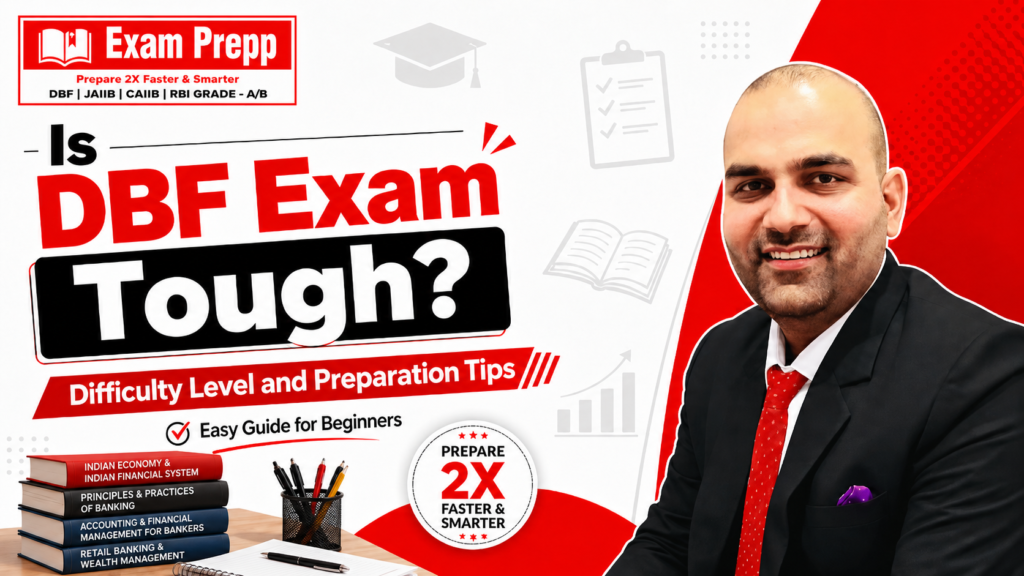
Is DBF Exam Tough? Difficulty Level and Preparation Tips
Are you wondering, Is DBF Exam Tough? Many graduates and banking aspirants planning to step into the financial sector ask this very question before starting their preparation journey for the Diploma in Banking and Finance (DBF) exam conducted by the Indian Institute of Banking and Finance (IIBF). Understanding the exact DBF exam format, difficulty levels, and syllabus structure is the best way to secure your target score on the first attempt.
In this comprehensive guide, we will break down the exact difficulty level of the DBF exam, understand the subjects, and provide you with a foolproof preparation strategy to clear the exam with confidence.
Table of Contents
- 1. Is DBF Exam Tough? A Balanced Overview
- 2. DBF Exam Pattern: Questions, Marks and Duration
- 3. DBF Exam Difficulty Level: Beginner-Friendly Analysis
- 4. Why Do Students Find the DBF Exam Difficult?
- 5. Is DBF Difficult for Beginners and Non-Commerce Students?
- 6. Which DBF Paper is the Most Difficult?
- 7. DBF vs JAIIB Difficulty Analysis
- 8. How Much Time is Required to Prepare for the DBF Exam?
- 9. How to Prepare for the DBF Exam Without Fear?
- 10. DBF Exam Preparation Plan (30-Day & 60-Day)
- 11. DBF Preparation Tips for High Scores
- 12. Common Mistakes to Avoid in DBF Preparation
- 13. Prepare DBF Under the Guidance of Sunderpal Dahiya Sir
- 14. DBF Exam Preparation with Exam Prepp
- 15. Best Resources for DBF Preparation
- 16. Important Links for DBF Aspirants
- 17. Final Words
- 18. FAQs on DBF Exam Difficulty Level
Is DBF Exam Tough?
To give you a direct and honest answer to the question, Is DBF Exam Tough? No, the DBF exam is not extremely tough, but it is certainly not an exam you can pass without studying. If you go in expecting general knowledge-type questions, you might face a hard time. The exam requires a clear conceptual understanding of core banking, economy, and financial accounting principles.
Think of DBF as a professional credential. It is designed to make you industry-ready. This means the questions are practical, case-study-oriented, and concept-heavy. For beginners, terms like “Statutory Liquidity Ratio (SLR)”, “Annuities”, “Depreciation”, or “Capital To Risk-Weighted Assets Ratio (CRAR)” might feel like a foreign language initially. However, once you break down these concepts with proper classes, the entire syllabus becomes logical and highly scoring.
With structured study, regular revision, and reliable DBF mock tests, passing the DBF exam on your very first attempt is completely manageable.
DBF Exam Pattern: Questions, Marks and Duration
The DBF exam is objective in nature. Each paper is generally conducted for 100 marks, and candidates should refer to the latest IIBF notification before applying.
DBF Exam Difficulty Level: Beginner-Friendly Analysis
When analyzing the overall DBF Exam Difficulty Level, it is helpful to look at it subject-by-subject. The IIBF DBF syllabus consists of four major papers. Let us examine the difficulty level of each paper systematically:
| Subject / Paper | Difficulty Level | Why Students Find It Difficult | Preparation Tip |
|---|---|---|---|
| Paper 1: Indian Economy & Indian Financial System (IE&IFS) | Moderate | Large theoretical syllabus with complex financial sector concepts and economic policies. | Focus on macroeconomics, regulatory bodies (RBI, SEBI), and keep up with current financial updates. |
| Paper 2: Principles & Practices of Banking (PPB) | Easy to Moderate | Wide coverage of real-life banking operations, technology, and customer relationships. | Relate concepts with daily banking services. High focus on digital banking and retail banking guidelines. |
| Paper 3: Accounting & Financial Management for Bankers (AFM) | Moderate to High | Involves heavy numerical components, balance sheets, ratios, and core accounting guidelines. | Do not memorize formulas. Practice step-by-step calculations and understand the “why” behind entry debits/credits. |
| Paper 4: Retail Banking & Wealth Management (RBWM) | Easy | Highly practical, dealing with credit/debit cards, housing loans, and personal investment products. | Extremely scoring paper. Study product structures, mutual funds basics, and recovery mechanisms. |
Why Do Students Find DBF Exam Difficult?
If the exam is manageable, why do thousands of students fail it every year? Here are the most common reasons why candidates struggle:
- Starting Preparation Late: Many candidates wait for the exam date announcement and try to cram the vast syllabus in just 10-15 days.
- Lack of Concept Clarity: Trying to memorize multiple-choice questions (MCQs) directly without learning the foundational theories.
- Weak Accounting Basics: Skipping numeric-heavy chapters in Accounting and Financial Management (AFM), losing crucial straight marks.
- Unfamiliarity with Banking Terminology: Non-commerce and non-banking background students getting overwhelmed by financial jargon.
- Zero Mock Test Practice: Entering the exam hall without practicing time-bound mock tests, leading to poor time management.
- Depending Only on Random PDFs: Studying from unverified, outdated, or unstructured PDF notes available on social media groups.
Is DBF Difficult for Beginners and Non-Commerce Students?
This is a major concern for B.Sc, B.A., and B.Tech graduates. If you have no background in business studies or core banking, you might be asking: Is DBF difficult for beginners who have never touched financial accounting?
The honest answer is: Only the Accounting & Financial Management (AFM) paper may feel challenging initially. For someone who has never seen a ledger account or a balance sheet, terms like “double-entry book-keeping” or “trial balance” can seem intimidating. However, this is just a temporary phase.
Is DBF difficult for beginners?
For complete beginners, the initial learning curve can feel steep, but it is entirely conquerable. If you are a beginner or a non-commerce student, follow these simple tips:
- Start your preparation with basic accounting terms (Assets, Liabilities, Capital, Revenue).
- Treat the Accounting paper like a practical math subject. Master the rules of debit and credit before moving to advanced calculations.
- Give yourself an extra 15-20 days compared to commerce graduates to build your foundational base.
- Utilize bilingual video lectures that explain complex financial formulas in simple, everyday language.
Which DBF Paper is the Most Difficult?
While difficulty is subjective, a majority of aspirants vote for Accounting & Financial Management for Bankers (AFM) as the most difficult paper. This is because it requires active problem-solving skills, financial mathematics, and conceptual accuracy.
On the other hand, Principles & Practices of Banking (PPB) and Retail Banking & Wealth Management (RBWM) are considered relatively easier because the concepts are highly relatable to our everyday interactions with banks.
| Paper Name | Difficulty Rank | Primary Focus Area |
|---|---|---|
| Accounting & Financial Management (AFM) | 1 (Most Difficult) | Numericals, YTM, Depreciation, Balance Sheet, Ratio Analysis |
| Indian Economy & Financial System (IE&IFS) | 2 (Moderate) | Economic Theories, Reforms, Monetary & Fiscal Policies |
| Principles & Practices of Banking (PPB) | 3 (Easy-Moderate) | Operational Guidelines, KYC, Credit Cards, Lending Policies |
| Retail Banking & Wealth Management (RBWM) | 4 (Easiest) | Retail Assets, Investment Products, Real Estate, Wealth Plans |
DBF vs JAIIB Difficulty Analysis
Many candidates get confused between the DBF Exam and the JAIIB Exam. Let us clear the air once and for all. The syllabus, subjects, and exam pattern of DBF and JAIIB are 100% identical.
When analyzing DBF vs JAIIB difficulty, you will find that the exam papers share the same set of questions. The only difference lies in eligibility: JAIIB is strictly for those already working in banks (members of IIBF), whereas DBF is designed for ordinary graduates and non-bank employees who want to enter the banking sector.
| Feature | DBF Exam | JAIIB Exam |
|---|---|---|
| Target Candidates | Graduates, College Students, Non-Bankers | Active Working Bankers / IIBF Members |
| Difficulty Level | Identical to JAIIB | Identical to DBF |
| Best For | Securing private bank jobs or gaining early promotions before joining public sector banks. | Incremental pay hikes and promotions in public & cooperative banks. |
| Preparation Approach | Needs structured classes since candidates lack real-world banking experience. | Easier to relate with since bankers handle these processes daily. |
To learn more about individual pathways, explore our specialized hubs: DBF Pillar Page, JAIIB Pillar Page, and CAIIB Pillar Page.
How Much Time is Required to Prepare for DBF Exam?
Depending on your current academic background and daily schedule, here are three highly realistic preparation timelines:
| Preparation Duration | Who is it for? | Required Daily Commitment | Preparation Approach |
|---|---|---|---|
| 30 Days | Commerce graduates or students with strong competitive exam experience. | 4 – 5 Hours Daily | Targeted concept classes, high-yield summary notes, and daily MCQ mock tests. |
| 60 Days | The balanced route. Best for working aspirants or regular college-goers. | 2 – 3 Hours Daily | 1.5 hours of concept videos + 1 hour of practice and revision of weak formulas. |
| 90 Days | Absolute beginners, non-commerce students, or people with highly busy schedules. | 1 – 2 Hours Daily | Deep concept learning, building basic accounting foundation from scratch, and extensive mock testing. |
How to Prepare for DBF Exam Without Fear?
Preparation fear comes from a lack of direction. If you follow this step-by-step strategy, you can face the DBF Exam with ultimate confidence:
- Start with the official DBF Syllabus: Know exactly what topics are covered. Do not waste time reading unnecessary business management or general accounting concepts.
- Understand Key Financial Terms first: Maintain a small notebook to write down abbreviations and definitions of core banking terms.
- Watch Premium Concept Classes: Rely on step-by-step video lessons that clear concepts rather than dry reading.
- Create Micro-Notes: Write down formulas, section numbers, and banking limit updates. This acts as your last-minute revision weapon.
- Attempt Chapter-Wise MCQs: Immediately after finishing a chapter, solve 20-30 practice questions to check your retention.
- Take Weekly Mock Tests: Simulate real exam conditions to track your speed and accuracy.
DBF Exam Preparation Plan: 30-Day and 60-Day Schedules
Having a structured DBF exam preparation plan is highly recommended for working professionals and graduates alike. Here are both rapid and complete schedules to guide your timeline:
30-Day DBF Preparation Plan
This rapid 30-day study schedule is ideal for aspirants looking to make a quick comeback and clear the exam in a single month:
| Timeline | Focus Area & Plan | Practice Strategy |
|---|---|---|
| Week 1 | Paper 1 (IE&IFS) + Core Banking Terminology Basics. Learn about financial systems and monetary policy. | Solve 50 topic-wise MCQs daily. Take 1 sectional test. |
| Week 2 | Paper 2 (PPB) – Cover retail assets, bank-customer relationship rules, and KYC. | Attempt full-length PPB mock tests. Highlight tricky cases. |
| Week 3 | Paper 3 (AFM) – Study Balance Sheet equation, Depreciation, and Ratio analysis. | Solve minimum 15 numerical problems every single day. |
| Week 4 | Paper 4 (RBWM) + Complete Mock Tests, Formula revisions, and past year question analysis. | Attempt at least 5 complete full-length mock tests under real exam limits. |
60-Day DBF Preparation Plan for Beginners
For complete beginners who want to build a rock-solid foundation, the 60-day plan is the absolute gold standard:
| Timeline | Weekly Milestones | Daily Routine |
|---|---|---|
| Weeks 1 – 2 | Deep-dive into Paper 1 & Paper 2 concepts. Focus on building banking sector vocabulary. | Watch 2 concept video classes. Read supplementary revision notes. |
| Weeks 3 – 4 | Conquer the Accounting (AFM) paper. Learn Ledger posting, Bank Reconciliation Statement, and Trial Balance. | Spend 1 hour understanding theory and 1 hour practicing basic calculations. |
| Weeks 5 – 6 | Cover Retail Banking (RBWM) along with solving chapter-wise MCQs for all four papers. | Focus on identifying recurring exam questions and understanding mistakes. |
| Week 7 | Full-length Mock Testing. Identify weak chapters and review key formulas. | Attempt one full-length mock test every alternate day. Analyze your mistakes meticulously. |
| Week 8 | Final intensive revision. Review your self-made short notes and study key banking updates. | Re-read formulas and attempt high-yield daily quizzes. Keep calm and avoid studying new topics. |
DBF Preparation Tips: Proven Strategies
Implementing targeted DBF preparation tips will significantly improve your overall score and lower your study stress. To ensure your hard work translates to high scores, keep these pro tips in mind:
- Master the Rules of Debit and Credit: This forms the baseline of the AFM paper. Once this is clear, half your battle in accounting is won.
- Learn Full Forms and Abbreviations: IIBF regularly tests abbreviations like SARFAESI, BASEL, CIBIL, NAV, and FEMA.
- Stay Updated with RBI Notifications: Keep track of repo rate changes, SLR, CRR modifications, and recent banking circulars.
- Practice Topic-Wise Questions: Don’t move to a new chapter until you have solved at least 20-30 MCQs of your current chapter.
- Do Not Postpone Mock Tests: Do not wait to finish 100% of your syllabus before starting mock tests. Start them when you are 60-70% done.
Common Mistakes to Avoid in DBF Preparation
Even smart students fail because of simple, easily avoidable mistakes. Ensure you protect your preparation by avoiding these pitfalls:
- Ignoring the Official Syllabus: Studying outdated topics from unverified study materials can cost you precious marks.
- Reading Theory Without Practicing MCQs: Knowing the theory is useless if you don’t know how questions are framed in the actual examination.
- Relying on “Shortcut” PDFs: Quick revision PDFs are meant for revision, not for core learning. Do not skip textbook concepts.
- Leaving AFM Numerical Practice for the Last Week: Numericals require systematic practice and muscle memory. Start practicing them from Day 1.
- Not Maintaining a Timetable: Consistency is key. Studying 10 hours on Sunday and 0 hours on weekdays will not yield results.
Prepare DBF Under the Guidance of Sunderpal Dahiya Sir
At Exam Prepp, DBF aspirants can prepare under the guidance of Sunderpal Dahiya Sir, who has more than 10 years of teaching experience in banking, finance, current affairs and competitive exam preparation.
His teaching style is simple, bilingual and exam-oriented, which makes DBF preparation easier for beginners, non-commerce students and working aspirants. Students get concept-based classes, chapter-wise notes, MCQ practice, mock test support and proper revision guidance.
If you are confused about where to start, Exam Prepp helps you prepare step-by-step with classes, app-based learning, free YouTube content and structured practice resources.
DBF Exam Preparation with Exam Prepp
Why choose Exam Prepp as your trusted learning partner? Our courses are specifically structured keeping beginner limitations in mind:
- Bilingual Video Lectures: We explain complicated economic and accounting concepts in a simplified mix of English and Hindi.
- Mock Tests & Practice: Thousands of high-yield exam-relevant questions with detailed textual explanations.
- Chapter-Wise Structured Notes: No more reading heavy PDFs. Access concise, point-to-point notes optimized for rapid revision.
- Weekly Interactive Support: Get your doubts cleared by subject matter specialists.
Best Resources for DBF Preparation
Equip yourself with the absolute best resources to accelerate your preparation journey:
Important Links for DBF Aspirants
Quick access to all essential portals on Exam Prepp:
Final Words
So, is the DBF Exam tough? Ultimately, the answer depends entirely on your strategy. If you try to memorize answers blindly, it will feel extremely tough. However, if you focus on concept clarity, make short notes, practice questions regularly, and utilize the right mock tests, the DBF exam is highly manageable and easy to clear.
Do not let fear delay your career plans. Start your DBF preparation early, stay regular with your study routine, and walk into the exam hall with complete peace of mind. You’ve got this!
FAQs on DBF Exam Difficulty Level
Q1: Is DBF Exam tough?
No, the DBF exam is not extremely tough, but it requires systematic study. You need a decent understanding of banking processes, economic concepts, and accounting practices to secure a passing score of 50% in each subject.
Q2: Is DBF Exam difficult for beginners?
It can feel slightly challenging to absolute beginners because of specific terminologies like NPV, SLR, and CRR. However, with clear classes and chapter-wise study, beginners can easily master the concepts within 60 days.
Q3: Can non-commerce students clear DBF Exam?
Yes, thousands of non-commerce graduates clear the DBF exam every year. You just need to spend extra time understanding the foundational rules of double-entry accounting in the AFM paper.
Q4: Which DBF paper is most difficult?
Accounting & Financial Management for Bankers (AFM) is widely considered the most challenging paper because it contains complex numerical calculations and formula-based questions.
Q5: How much time is required for DBF preparation?
A balanced preparation time is 60 to 90 days. During this period, devoting 2 hours daily is more than enough to cover the concepts, solve topic-wise MCQs, and practice mock tests.
Q6: Can I clear DBF Exam in 30 days?
Yes, you can clear the DBF exam in 30 days if you have a commerce background or strong competitive exam preparation experience. You will need to dedicate 4-5 hours daily for intensive study.
Q7: Is mock test important for DBF Exam?
Absolutely. Mock tests are highly critical. They help you get used to the computer-based format, improve your pace, and highlight chapters where your conceptual understanding is weak.
Q8: How should beginners prepare for DBF Exam?
Beginners should start by reviewing the syllabus, learning the basic terminology, watching conceptual videos, practicing chapter-wise MCQs, and taking weekly online mock tests on Exam Prepp.
Q9: Is DBF easier than JAIIB?
No, both exams are exactly identical in terms of the syllabus, questions, paper structures, and difficulty. The only difference is that JAIIB is for working bank employees while DBF is for non-bankers.
Q10: Where can I get DBF mock tests and classes?
You can access high-quality mock tests, free bilingual courses, and concise notes directly on the Exam Prepp App or by visiting the official Exam Prepp Website.