
If you are pursuing graduation and want to complete it with a stronger banking-focused profile, DBF is a useful option to explore for your next step.
DBF can help you make your graduation years count for your career. Alongside your degree, you can work towards an additional qualification, build banking and finance knowledge and prepare explanations and practical study outputs you can demonstrate.
How DBF Can Help You
- Add professional focus to your degree: connect academic learning with banking and finance.
- Start preparation before graduation ends: build concepts at a sustainable pace.
- Develop a stronger next-step profile: combine your degree, qualification status and useful skills.
What This Can Add to Your Career
Supercharge your degree by adding knowledge and capability: DBF can complement graduation with a professional learning focus. Your degree and the applicable recruitment rules determine job eligibility; DBF can enrich the preparation you bring to those opportunities. The plan below shows how to balance both.
Make your graduation years count for banking with Exam Prepp
Take the next step with the DBF May 2027 course on the Exam Prepp app. Use structured classes, subject practice, revision and mentorship to turn your interest into a preparation routine. Explore the current course details and choose the support that fits your goal.
For personal guidance, contact Sunderpal Dahiya Sir through direct call or WhatsApp. Share your background and target so the discussion can focus on your study needs.
1. Can You Pursue DBF While Studying for Graduation?
Yes, eligible students can take DBF without waiting to complete graduation. IIBF lists Class 12 or equivalent in any discipline as an eligibility route for non-members. Students from Commerce, Arts or Science can therefore consider it, subject to the other applicable conditions.
Bank/FI employees eligible for ordinary IIBF membership should check the JAIIB route. A college student’s eligibility for DBF is separate from the academic and other criteria for a later job application.
Before registering, compare your college examination calendar with the IIBF schedule. Preparation classes, IIBF examination registration and your university programme are separate commitments.
2. What Each Part of the Combination Gives You
| Part of your preparation | Its purpose | What you should be able to show |
|---|---|---|
| Graduation | Academic learning and the degree required where a recruitment prescribes it | A completed degree, sound subject knowledge and satisfactory academic performance. |
| DBF | An additional banking-and-finance qualification and structured learning | An accurate qualification record and the ability to explain what you studied. |
| Practical skills | Turn learning into usable work habits | Clear communication, basic spreadsheet ability and organised problem-solving. |
| Recruitment preparation | Prepare for the specific selection process | Targeted practice, current knowledge and readiness for each required stage. |
These parts complement one another. DBF does not replace a degree, a recruitment examination, an internship requirement or the employer’s selection process.
3. How DBF Can Make College Learning More Useful
DBF has four papers: Indian Economy & Indian Financial System; Principles & Practices of Banking; Accounting & Financial Management for Bankers; and Retail Banking & Wealth Management. Together they provide a framework for exploring how financial ideas relate to institutions, decisions and customer needs.
Do more than prepare for the next test. After studying a concept, ask where you would encounter it in a business discussion, a news report or an interview. That question helps you connect academic learning with a possible career.
Example: connect an accounting idea with a business situation
Imagine a hypothetical shop that records sales but collects some payments later. Draw a simple monthly cash table. Identify when money comes in and when rent, purchases and other expenses must be paid. Explain why the timing matters.
This original exercise helps you practise analysis and explanation. It does not require access to a real customer’s financial records.
4. How the Approach Can Fit Different Degrees
| Your programme | A possible learning connection | What to do alongside it |
|---|---|---|
| B.Com | Connect accounting and business learning with banking examples | Practise financial explanations and spreadsheet exercises. |
| BBA or management studies | Link business decisions and customer needs with financial services | Develop presentations, teamwork and problem-solving. |
| BA or social-science programmes | Connect economic or social discussions with financial access | Build numerical confidence and practise unfamiliar accounting basics. |
| B.Sc., engineering or other programmes | Develop an additional understanding of the financial sector | Apply analytical strengths while learning banking terminology systematically. |
These are suggested connections, not claims that every university syllabus overlaps with DBF. Keep your own degree requirements and career interests at the centre of the plan.
5. How It Can Help When You Complete Graduation
- You can begin career preparation with a foundation. Instead of encountering every banking term for the first time, you can build on concepts you already understand.
- You can explain a purposeful interest in the sector. Discuss why you studied DBF and give an example of something you learned.
- You can present an additional qualification accurately. List DBF separately from your degree once you have completed it.
- You can connect theory with interview situations. Practise discussing a customer need, a business problem or an economic development.
- You can make more informed career choices. Use your experience of studying the subject to judge whether the field suits your interests.
- You can reuse relevant learning. Build further preparation around shared concepts while completing the specific requirements of your target examination.
IIBF states that the Indian Banks’ Association has approved DBF as a desirable qualification alongside other prescribed entry-level qualifications for bank recruitment. This does not mean every employer awards it preference, bonus marks or a placement guarantee.
6. Use the Foundation for Your Chosen Career Route
| Your intended route after graduation | How to use DBF learning | What remains essential |
|---|---|---|
| Bank PO or other bank recruitment | Use relevant banking concepts in awareness and interview preparation | The notification’s eligibility, aptitude, English, current affairs and selection stages. |
| RBI Grade B or other specialised examinations | Reuse relevant economy and finance foundations | The target syllabus, required depth, current material and examination-specific practice. |
| Entry-level banking or financial-services applications | Explain your learning and apply it to the advertised responsibilities | Role-specific qualifications, employer assessment, communication and practical skills. |
| Further study | Use the learning to explore your interest in finance | The institution’s admission criteria and the requirements of the programme. |
Before applying, check the exact qualification and result cut-off date. Holding DBF does not make an unfinished graduation count as a completed degree or make you eligible for every vacancy.
7. A Roadmap from Early College to Graduation
| Stage | Suggested focus | Useful output |
|---|---|---|
| Early college | Explore banking, check eligibility and establish a manageable study routine | A syllabus checklist, basic notes and a realistic examination plan. |
| Middle of the programme | Study systematically and practise the remaining DBF subjects | Reviewed question practice and, if successful, DBF completion. |
| Final academic year | Protect degree performance and strengthen target-career preparation | A truthful CV, recruitment checklist, current-affairs routine and mock practice. |
| After graduation | Apply where eligible and demonstrate what you know | Complete applications and targeted preparation for each selection stage. |
Adapt the stages to the length of your degree and your starting point. A student in a four-year programme need not follow a three-year timetable. Your DBF completion depends on preparation, examination opportunities and results; it is not automatic at any particular college stage.
8. A Manageable Weekly Routine Alongside College
Start with a schedule that you can sustain. For example, a student might allocate six hours a week to supplementary banking learning outside college obligations.
| Work | Illustrative weekly time | Output |
|---|---|---|
| Concept lessons | 3 hours | Understand a small, clearly defined set of topics. |
| Question practice | 1.5 hours | Solve questions and identify weak areas. |
| Revision and error review | 1 hour | Revisit mistakes and update short notes. |
| Spoken explanation or practical exercise | 30 minutes | Explain one concept or complete one simple task. |
This is a planning illustration, not an estimate that six hours weekly will clear DBF within a fixed period. Increase or redistribute time according to your readiness, syllabus coverage and examination dates.
During university examination periods, reduce the supplementary workload and prioritise your degree. Keep a brief revision habit if feasible, then return to the fuller routine afterwards.
9. Graduate with Evidence of Learning, Not Only Certificates
Create a small collection of original practice work. It can help you remember concepts and give you something concrete to discuss; it is not an official DBF requirement.
- A one-page concept explanation: choose a topic and explain it clearly for a beginner.
- A hypothetical cash-flow worksheet: use invented figures to demonstrate a simple business problem.
- A dated news summary: separate the reported facts from your own interpretation.
- A customer-conversation script: explain a product’s purpose and limitations in plain language.
- A recorded mock answer: review whether you speak accurately, directly and concisely.
Use fictional examples and your own work. Do not invent employment, claim professional advice experience you do not have, or use someone else’s confidential information.
10. How to Present DBF on Your CV and in an Interview
CV example after successful completion
Additional Qualification
Diploma in Banking & Finance (DBF), Indian Institute of Banking & Finance (IIBF) — Completed [Month, Year].
If you are still preparing
Use a separate line such as “Currently preparing for IIBF DBF”. Do not place it among completed qualifications or imply that registration equals passing.
Sample interview explanation
“During graduation, I chose to study banking and finance in a structured way through DBF. It helped me connect concepts with practical situations. For example, I used a hypothetical business exercise to understand the difference between earnings and the timing of cash collections. I am now building on that foundation for the role I am applying for.”
Adapt the answer to your actual learning. A genuine example is more useful than an impressive-sounding claim that you cannot explain.
11. A Possible DBF-to-JAIIB Route After Joining a Bank
Under IIBF’s published conditions, a candidate who completes DBF before joining a Bank/FI that is an institutional member can obtain ordinary membership and apply to convert the DBF certificate to JAIIB, with the applicable fee. It requires an application and approval; joining the bank alone does not complete the process.
If you join a Bank/FI before completing DBF, check the applicable credit-transfer provisions and membership route promptly. Do not assume you can continue appearing under the same category.
Any employment benefit or increment depends on the applicable employer rules. This article does not promise a salary increase from DBF itself.
12. When Is Graduation Plus DBF a Sensible Choice?
- You have a genuine interest in banking or finance.
- You meet DBF eligibility and understand the examination commitment.
- Your degree workload leaves enough time for additional study.
- You can budget for examination fees, study resources and optional coaching.
- You will practise and revise instead of collecting a qualification without understanding it.
If you are uncertain about the sector, first explore introductory learning and the syllabus. If an important university examination or recruitment test is near, prioritise that immediate goal and choose a more suitable DBF window.
A constructive plan protects your graduation performance while adding relevant learning. The value comes from using both well.
13. Prepare with the Exam Prepp App
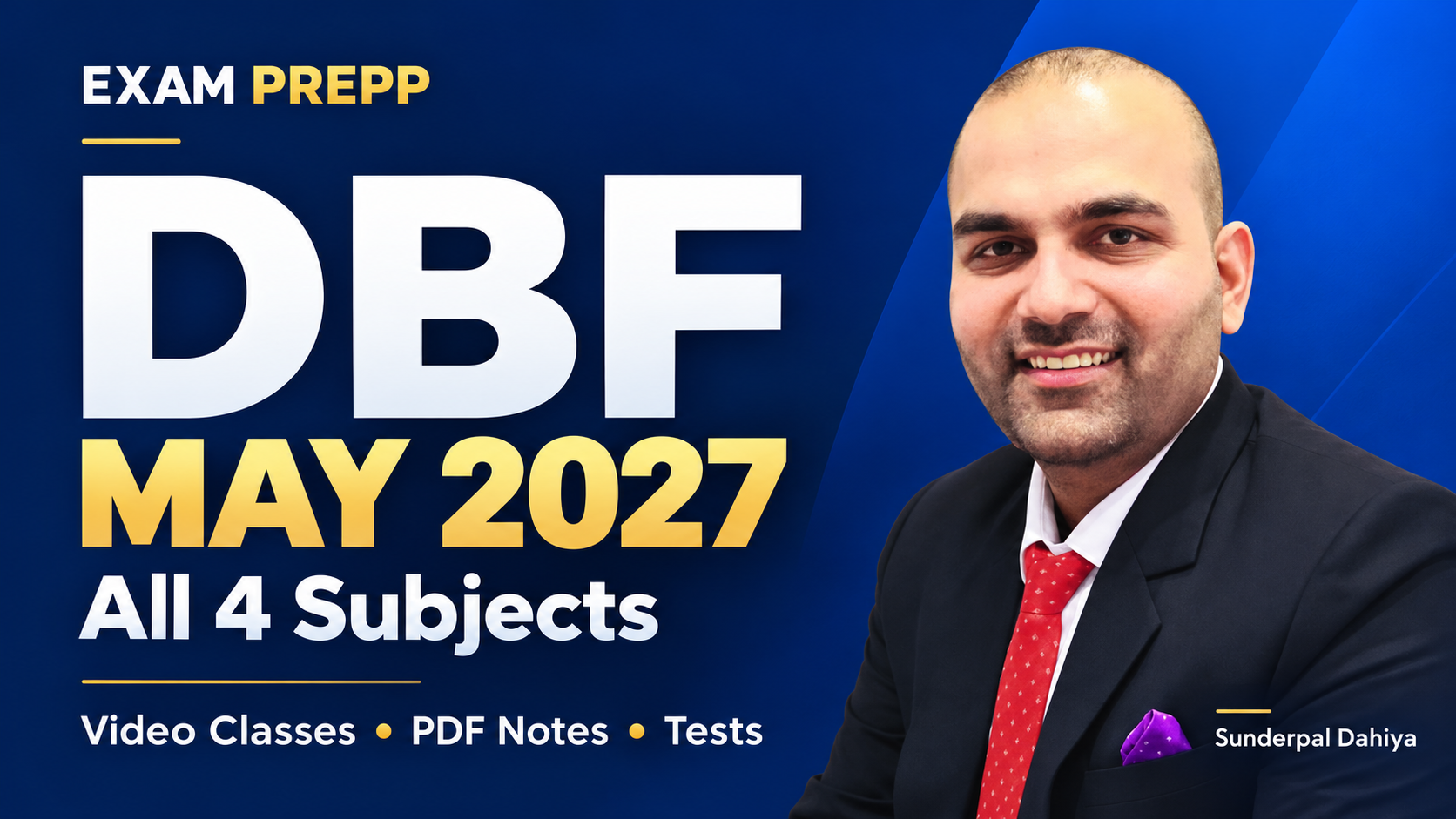
Students seeking guided preparation can explore DBF classes on the Exam Prepp app under Sunderpal Dahiya Sir. The DBF May 2027 course listing describes all four subjects, English content with Hinglish explanations, recorded lessons, doubt sessions, PDF notes, quizzes, chapter-wise MCQs, test-series support and personalised mentorship.
Discuss your college timetable, subject background and career goal when choosing a study plan. Use the lessons to build understanding, practise questions regularly and explain concepts in your own words.
Check the current course features, fees and access validity before enrolling. IIBF examination registration is separate from Exam Prepp preparation.
Frequently Asked Questions
Can I do DBF during graduation rather than afterwards?
Yes, if you meet IIBF’s eligibility conditions. Plan it around your college workload and the examination schedule.
Is DBF only suitable for B.Com students?
No. The Class 12 eligibility route covers any discipline, subject to IIBF’s other conditions. Non-Commerce students may need additional time for unfamiliar topics.
Does DBF replace graduation for bank recruitment?
No. Meet the educational qualification specified in the relevant recruitment notification.
Will I get a banking job immediately after completing both?
Recruitment depends on vacancies, eligibility and selection. Use your learning to strengthen preparation and demonstrate relevant understanding.
How long should I study every day?
Choose a sustainable routine based on your starting point and deadline. Review progress rather than assuming a fixed number of minutes guarantees completion.
Should I complete DBF in my first college year?
It is an option if your readiness and workload allow it. There is no need to force a deadline that damages your academic performance.
Can I mention DBF on my CV while awaiting results?
Describe your status accurately. List it as completed only after successful completion is established.
Can DBF later be converted to JAIIB?
Eligible candidates can apply after joining a qualifying institution and obtaining ordinary membership, subject to IIBF’s conditions and the applicable process.
What should I do after graduation?
Confirm eligibility for your target roles, update your CV, strengthen current knowledge and practical skills, and prepare for the required selection stages.
Build Your Banking Foundation During College
- All four DBF subjects with bilingual explanations.
- Recorded lessons, PDF notes, quizzes and question practice.
- Test-series support, doubt sessions and one-on-one mentorship.
Continue Your DBF Career Planning
References and Scope
Sources checked on 9 October 2026. The schedules, CV examples and learning exercises are original guidance, not official course requirements. Confirm current eligibility and processes before applying.