
If you are preparing for RBI Grade B, NABARD, SEBI or another financial-sector examination and want clearer foundations, DBF is a useful option to explore for your next step.
DBF can help organise your understanding of banking, the financial system and related economic and financial concepts. Where topics connect with your target syllabus, you can reuse the foundation and then build the deeper exam-specific treatment.
How DBF Can Help You
- Make the basics clearer: study concepts before tackling demanding questions.
- Connect preparation intelligently: identify useful topic links instead of duplicating all study.
- Add a professional learning goal: develop your banking-focused qualification profile alongside recruitment preparation.
What This Can Add to Your Career
A combined plan can support both knowledge development and a focused career goal. Use the comparison below to understand the connections and retain specialist subjects, current developments and target-exam practice.
Strengthen your foundation while preparing for regulatory exams with Exam Prepp
Take the next step with the DBF May 2027 course on the Exam Prepp app. Use structured classes, subject practice, revision and mentorship to turn your interest into a preparation routine. Explore the current course details and choose the support that fits your goal.
For personal guidance, contact Sunderpal Dahiya Sir through direct call or WhatsApp. Share your background and target so the discussion can focus on your study needs.
Preparing for RBI Grade B, NABARD Grade A or SEBI Grade A can feel overwhelming when you are new to economics and finance. You encounter technical terms in the syllabus, unfamiliar concepts in current affairs and questions that demand more than memorising definitions.
The Diploma in Banking & Finance (DBF) from the Indian Institute of Banking & Finance (IIBF) can provide a structured starting point. Its economy, financial-system and banking content creates useful connections with these examinations.
For an eligible beginner with enough preparation time, a practical strategy is to begin with the common DBF foundation while continuing regulatory-exam preparation alongside it. You can work towards an additional qualification and reuse relevant learning for your main target.
The advantage comes from understanding and applying the shared concepts. DBF is not compulsory for these recruitments and does not create bonus marks or preferential selection.
1. Why Indian Economy & Indian Financial System Is the Starting Point
DBF’s first paper, Indian Economy & Indian Financial System (IE&IFS), brings economic concepts and financial institutions into one study framework. Its modules address Indian economic architecture, economic concepts related to banking, Indian financial architecture, and financial products and services.
That makes it a useful bridge between learning basic theory and following economic or financial news. Instead of collecting isolated facts, you begin organising them around concepts.
For example, when you read a policy announcement, ask three questions:
- What problem is the policy trying to address?
- Through what institutions or channels will it work?
- What trade-offs or limitations could affect the outcome?
These questions help you move from remembering an announcement to understanding its significance.
2. Where the Syllabus Connects
The table below is an educational comparison of published syllabi. It identifies shared areas, rather than predicting marks or assigning an overlap percentage.
| Common topic cluster | Useful connection with RBI Grade B General | Useful connection with NABARD Grade A General/RDBS | Useful connection with SEBI Grade A General |
|---|---|---|---|
| Growth, economic reforms and globalisation | ESI foundation | ESI foundation | Economics background |
| Inflation, monetary and fiscal policy | Economy and finance concepts | Economic understanding | Economics and finance |
| Financial institutions and markets | Finance foundation | Rural banking context | Finance foundation |
| Banking, inclusion and microfinance | Financial-system understanding | Rural-credit context | Financial inclusion |
| Accounting and financial analysis | Selected supporting concepts | Selective supporting value | Accountancy foundation |
The relevance varies by topic, stream and examination cycle. A shared heading can still be tested at a different depth or through a different question format.
3. How DBF Supports RBI Grade B Preparation
For RBI Grade B General, the clearest connections are with the economy-related areas of Economic and Social Issues and the finance component of General Finance and Management. Published RBI material includes economic development, policy, financial institutions, markets and inclusion.
Use DBF to build understanding, then extend each relevant topic with current developments and RBI-style practice. Keep separate preparation for management, social issues, descriptive answers, English and Phase I aptitude. This comparison does not extend to the specialist DEPR or DSIM streams.
An example: turn one topic into several study outputs
Suppose you study inflation. Do more than underline a definition:
- Write a short explanation in your own words.
- Solve objective questions on the concept.
- Read a recent official release and record its date and key observation.
- Write a short answer explaining a policy challenge.
- Review whether you have distinguished the concept from the current data.
This sequence is a suggested learning method. It combines foundational study with the analysis and writing practice needed for your target exam.
4. How DBF Supports NABARD Grade A Preparation
NABARD’s published ESI syllabus includes the economy, inflation, development, rural banking and financial institutions. These areas provide useful connections with DBF study.
However, Agriculture and Rural Development requires substantial separate preparation. Crop production, soil, irrigation, animal husbandry and other agriculture topics cannot be treated as completed through a banking qualification. Rural schemes, social issues and current developments also need focused coverage.
An example: connect a financial concept to a rural problem
Imagine studying how access to credit can support a small enterprise. For NABARD-oriented practice, extend that discussion to a hypothetical rural borrower:
- What is the borrower’s income pattern?
- What costs must be financed before income arrives?
- What could interrupt repayment?
- What information would help assess the borrower’s needs?
This is an original practice exercise, not a predicted question. Its purpose is to help you apply a financial concept to a rural setting instead of merely recalling terminology.
5. How DBF Supports SEBI Grade A Preparation
For SEBI Grade A General, useful connections include economics, financial markets and accountancy. DBF can help establish relevant fundamentals, but SEBI’s published syllabus also requires management, costing and specified Companies Act coverage.
Complete the SEBI syllabus topic by topic. Practise its question style, accounting depth and numericals separately, and maintain preparation for the aptitude and English components. The comparison here is for the General stream, not Legal, IT or other specialist streams.
6. How DBF Can Give You a Preparation Edge
These are potential learning benefits, not measured score gains or selection guarantees.
A. Reuse your understanding
Learning a common concept carefully once gives you something to build on when it appears in another syllabus. Keep one core explanation, then add separate notes for each exam’s requirements.
B. Make current affairs easier to interpret
When terminology is familiar, you can spend more time understanding why a development matters. Your notes become more useful when they connect the event, its background and its implications.
C. Strengthen explanations
Practise moving from “what it means” to “how it works” and “what limits it.” This habit can improve the substance of practice answers and interview discussions.
D. Work towards an additional qualification
Completing DBF gives you a separate IIBF qualification while you pursue your recruitment goal. Its value should be considered alongside the study effort, examination fees and available time.
E. Build a consistent routine
A structured course can provide direction to a beginner. The routine becomes valuable when you regularly revise, practise questions and correct errors.
7. Should You Complete DBF Before Starting RBI or NABARD Preparation?
Start the common foundation first; continue your target-exam preparation in parallel. You do not need to wait for a DBF result before beginning current affairs, aptitude or writing practice.
| Your situation | Suggested approach |
|---|---|
| Beginner with a long preparation window | Start the shared foundations, pursue DBF if eligible, and develop target-exam skills alongside it. |
| Already comfortable with economy and finance | Assess whether the full qualification adds enough value; avoid unnecessarily repeating familiar material. |
| Recruitment examination is approaching | Prioritise its syllabus gaps, revision and mocks; use common DBF material selectively. |
| Bank/FI employee eligible for IIBF ordinary membership | Check the applicable JAIIB route instead of assuming DBF eligibility. |
Preparing for DBF and passing DBF are different commitments. Full DBF completion requires preparation for all four papers, including topics with limited relevance to your main recruitment exam.
8. A Practical Weekly Plan
The following allocation is an illustration for a student with 20 focused study hours a week. It is not an official timetable or a fixed requirement.
| Work area | Weekly time | Expected output |
|---|---|---|
| Shared economy and finance foundations | 6 hours | Concept notes and related questions |
| Target-exam syllabus gaps | 5 hours | Management, social issues, ARD or other required topics |
| Current affairs and official reports | 3 hours | Dated updates connected to syllabus topics |
| Aptitude and English | 3 hours | Timed practice and error review |
| Writing, revision and tests | 3 hours | Practice answers and a reviewed test |
If you are also pursuing full DBF certification, budget additional time for its remaining papers or adjust the allocation according to your examination dates. Do not assume that shared study alone completes both syllabi.
9. Use One Notebook, with Separate Exam Extensions
For every shared topic, organise your notes into four parts:
- Core concept: your concise explanation.
- Current development: the update, source and date.
- Target-exam extension: additional depth or related topics required by that syllabus.
- Practice: questions, answer outlines and mistakes to revisit.
For example, after learning a financial-market concept, practise explaining it without notes. Then check the target syllabus, add any missing subtopics, and attempt appropriate questions. This helps you reuse learning without overlooking differences.
10. Prepare for DBF with the Exam Prepp App
Students seeking guided learning can explore DBF classes on the Exam Prepp app under Sunderpal Dahiya Sir. The DBF May 2027 course listing describes coverage of all four subjects, English content with Hinglish explanations, recorded lessons, doubt sessions, PDF notes, quizzes, chapter-wise MCQs, test-series support and personalised mentorship.
Use the course to learn the foundation, then maintain an explicit checklist for your regulatory-exam syllabus. Discuss your background and main examination goal when choosing a study plan.
Explore DBF classes on the Exam Prepp app
Read the DBF guide · Explore RBI Grade B preparation · Read: What After 12th?
Check current course features, fees and access validity before enrolling. Exam Prepp provides preparation; IIBF examination registration is a separate step.
Frequently Asked Questions
Does DBF cover most of the entire RBI Grade B syllabus?
There is useful overlap in economy and finance, but a percentage would require a defined topic-by-topic method. Social issues, management, current developments, aptitude and writing still require dedicated work.
Is DBF compulsory for RBI, NABARD or SEBI recruitment?
No. Check the relevant recruitment notification for its prescribed qualifications. DBF is an optional additional learning and qualification route.
Can I prepare for DBF and RBI Grade B together?
Yes, if you are eligible for DBF and have enough time. Study the common concepts together and maintain separate checklists for each examination.
Does DBF replace NABARD ARD preparation?
No. Agriculture and Rural Development needs its own syllabus coverage and practice.
Will DBF give me extra marks or a guaranteed advantage in selection?
This article makes no claim of bonus marks, preferential selection or guaranteed results. The proposed edge is better preparation through reusable understanding and disciplined practice.
What should a beginner do first?
Compare the syllabi, choose the shared topics, and start learning them. Begin current affairs, aptitude and writing alongside that work. Decide on DBF certification after considering eligibility, cost and study time.
Teacher’s note: Build the foundation early and practise for your target examination from the beginning. पहले common concepts मजबूत करें और साथ-साथ अपने target exam की तैयारी जारी रखें।
Sources and Scope
This article presents an educational comparison and suggested study strategy, not an official equivalence between examinations. Sources checked on 9 October 2026. Verify the notification for your intended cycle before finalising your plan.
- IIBF published DBF rules and detailed syllabus
- IIBF current DBF examination page
- RBI Grade B recruitment notice, panel year 2026
- RBI-authored 2026 notice, accessible PDF copy: Phase II syllabus on pages 36–38
- NABARD published ESI and ARD syllabus
- SEBI Grade A 2025 advertisement, including the General-stream syllabus; examinations held in 2026
- Exam Prepp current DBF course listings
Build Your DBF Foundation with Exam Prepp
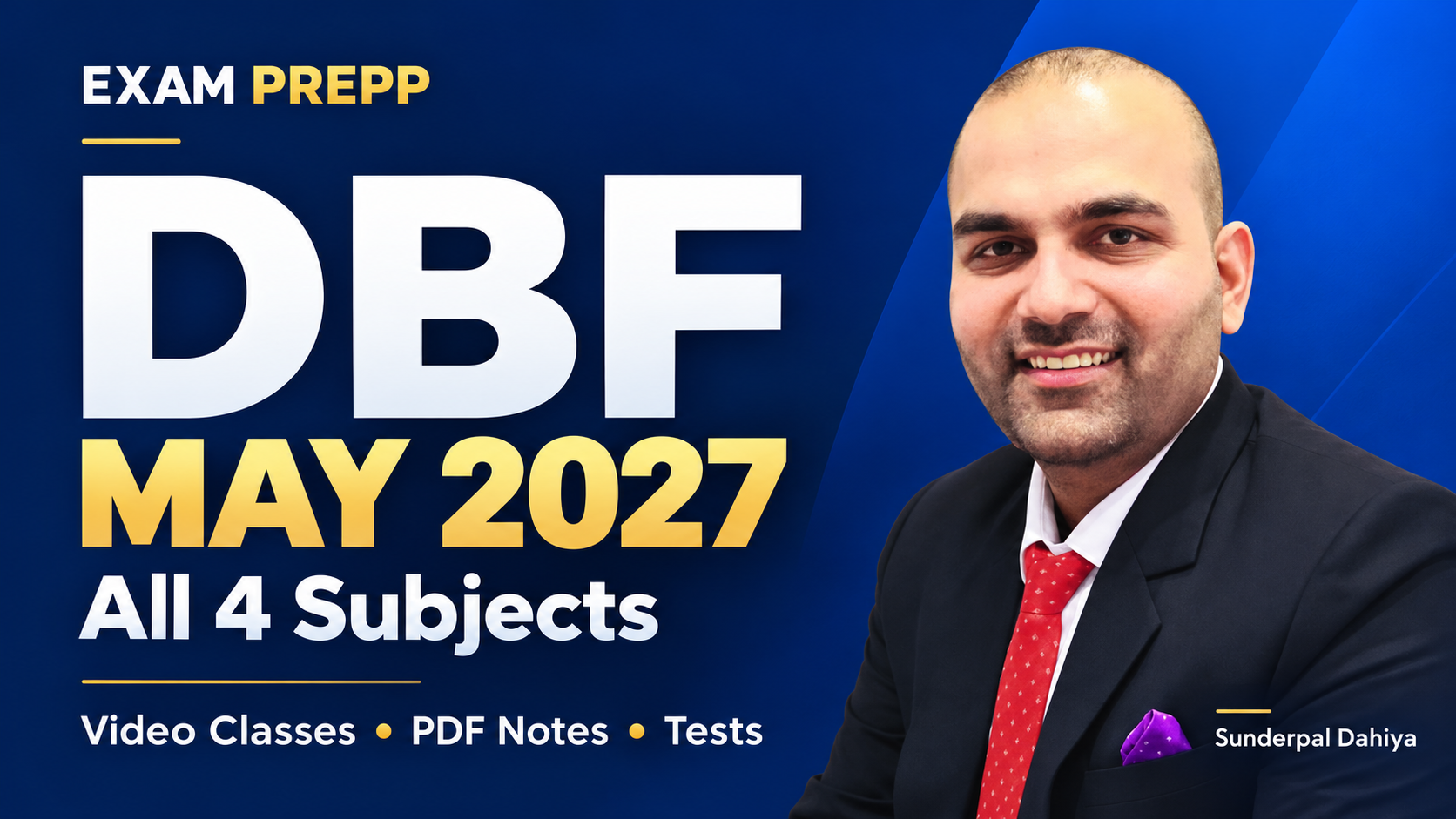
- All four subjects with English content and Hinglish explanations.
- Recorded classes and extra doubt-solving sessions.
- PDF notes, topic-wise quizzes and chapter-wise MCQs.
- Test-series support and one-on-one mentorship.
Personal mentorship through direct call or WhatsApp: discuss your study plan and doubts with Sunderpal Dahiya Sir.