EXAM PREPP · PREPARATION GUIDE
Bank Interview Preparation: A Practical 14-Day Answer and Revision Plan
By Sunderpal Dahiya Sir · 10+ years of teaching experience
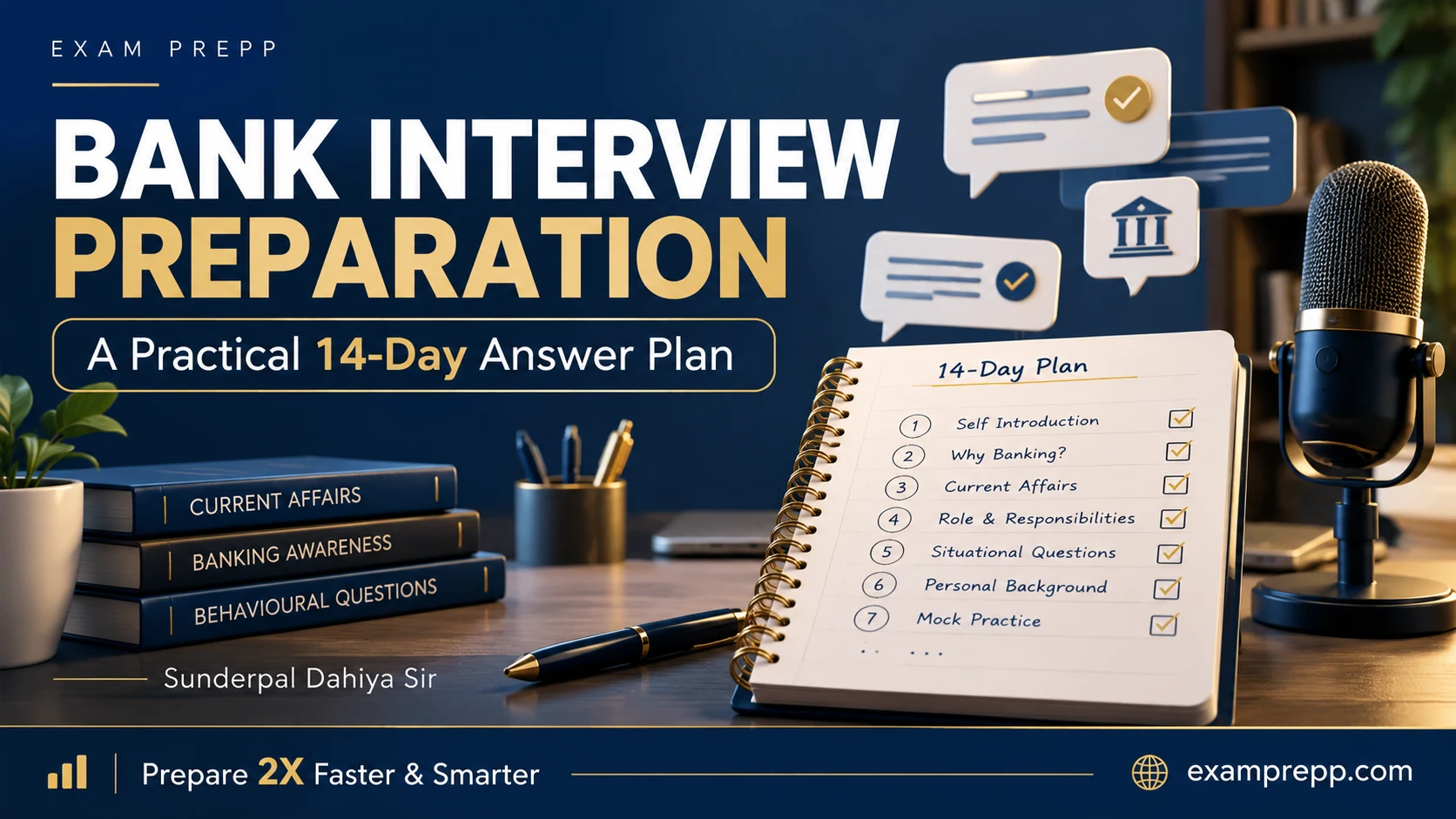
Your preparation should produce answers you can explain, not paragraphs you can only recite. Build a profile file, revise banking concepts, practise follow-up questions and review short recordings. This suggested 14-day plan shows what to prepare each day and how to assess your responses.
हिंदी में: जवाब को रटने की बजाय उसका point, अपना real example और banking role से connection तैयार करें। रोज़ थोड़ा बोलकर practice करें।
1. Start with a truthful one-page profile file
Write down your education, work experience, hometown, interests and reasons for choosing the role. Next to each point, add an example you could discuss. A claim such as “I am a good communicator” is easier to explore when you can describe a real situation, your action and what you learned.
For experienced candidates, identify the work you personally handled and the limits of your authority. Use generalised examples. Do not include customer names, account numbers, internal screenshots or confidential employer material in your practice notes or answers.
2. Give each answer a simple structure
For a concept question: meaning → example → relevance
Start with the direct meaning, add a simple example, and explain why it matters in banking. Keep technical words you cannot explain out of the opening sentence. Practise short answers first; expand when a follow-up asks for more detail.
For an experience question: situation → action → learning
Briefly describe the situation, explain your own contribution, and state the result or lesson. Avoid taking credit for a team outcome without explaining your role.
A self-introduction framework to personalise
“I am [name], from [place]. My background is in [education/work]. During [a real experience], I developed [relevant skill]. I am interested in this role because [specific connection to its work]. I have been strengthening my preparation through [real study or practice].”
Replace every bracket with accurate information and say it in your own words. This is a practice framework, not an answer to copy unchanged.
Example: a graduate with customer-facing voluntary experience could explain how they clarified a request and checked understanding. A working banker could discuss a general service situation while protecting customer and employer confidentiality. Neither candidate needs to invent lending or sales responsibilities.
3. Prepare question areas with a visible output
| Area | Practice prompt | What you should prepare |
|---|---|---|
| Personal profile | Why this role? What have you learned from your background? | A reason linked to the actual role and a real example |
| Banking concepts | Can you explain a familiar service or process simply? | Meaning, purpose, example and one limitation |
| Finance and economics | Can you explain a concept without jargon? | A short explanation and a practical connection |
| Current developments | What changed, and why could it matter to banking? | A dated fact, official source and your reasoned interpretation |
| Bank / institution research | What does the institution do, and why does the role interest you? | Notes from current official information |
| Behavioural situations | How would you respond to a misunderstanding or competing priorities? | A calm process and a real experience where relevant |
These are practice areas, not a prediction of panel questions or an official marking scheme. Align your preparation with the current recruitment notice and the responsibilities of the role.
4. Use a practical 14-day preparation plan
| Days | Preparation task | Output before you finish |
|---|---|---|
| 1–2 | Review your application and build the profile file | An introduction outline and five evidence-based examples |
| 3–4 | Revise banking foundations through question practice | Ten concepts explained aloud in your own words |
| 5–6 | Review finance/economics and confusing terms | Comparison notes and follow-up questions |
| 7 | Research the institution and the advertised role | One-page institution/role summary with source dates |
| 8–9 | Review relevant current developments | Short fact → explanation → relevance notes |
| 10 | Practise behavioural and work-profile situations | Three real examples with your actions clearly identified |
| 11 | Record a short mock session | A list of the three most useful improvements |
| 12 | Repair weak answers and try fresh follow-ups | Clearer responses without a memorised script |
| 13 | Review documents and interview instructions | A checklist drawn from your own call letter |
| 14 | Light revision, a short speaking session and practical arrangements | A calm final plan and a small revision sheet |
If the interview is sooner, combine preparation areas while protecting daily speaking practice. If you have more time, repeat the mock–review–improve cycle. This schedule is a suggested coaching plan, not a recruitment rule.
5. Run a mock that gives you useful feedback
Choose six to eight prompts from your profile, concepts and current developments. Ask a practice partner to add follow-ups rather than reading a fixed list in order. Record only with everyone’s agreement. After the session, select three improvements instead of rewriting every answer.
| Review area | Ask yourself | Useful correction |
|---|---|---|
| Directness | Did I answer the question in the opening sentence? | Start with the main point before background |
| Accuracy | Could I explain every technical term I used? | Replace unclear jargon or revisit the concept |
| Evidence | Did I give a real example when needed? | Use a specific action from your own experience |
| Listening | Did I respond to the follow-up actually asked? | Pause and clarify an ambiguous question |
| Delivery | Was my pace comfortable and my answer complete? | Use a short outline and remove repeated phrases |
This is a self-review checklist, not the bank’s official scoring rubric. Track whether your next recording improves on the same weak point. For memory-heavy concepts, use spaced review and self-quizzing; the IES study guide supports these general learning methods.
6. Respond honestly when you do not know
If you have not understood the question, ask for clarification. If you know the concept but not the current number, distinguish the two. For example: “I can explain what the term means, but I would like to verify the latest figure before quoting it.” If you do not know, acknowledge the gap briefly and stay attentive to the next question.
Do not attach an invented statistic to an otherwise reasonable answer. Maintain a dated sheet for figures and recent developments, using the relevant regulator or institution’s official information. Remove outdated entries as you revise.
7. Keep the final preparation practical
- Read your own call letter and recruitment instructions for required documents, reporting time and venue.
- Check that your profile notes match your application and supporting records.
- Practise using the language and communication requirements stated for the recruitment.
- Plan travel and keep the official contact instructions available.
- Review a short concept sheet rather than starting a large new resource on the final evening.
Document and language requirements vary. Use the instructions for your own recruitment; this general article does not establish a universal checklist for every bank.
8. Combine a question bank with speaking practice
The Exam Prepp Bank Interview Preparation eBook page explains the Interview Question Bank resource and links to its dedicated app listing. Use questions to find concepts you need to revise, then answer aloud without reading. A personal mock interview or one-to-one feedback is not automatically included with the eBook.
Build your concept base with Banking Awareness study material and RBI’s banking education material. For written-exam revision, see the General Awareness PYQ study plan. Refer to the SBI PO or IBPS PO guide when relevant, and verify recruitment-specific details with the current official notice.
Frequently asked questions
Should I memorise a self-introduction?
Prepare accurate points and real examples, then practise saying them naturally. Avoid a fixed script that you cannot adapt to a follow-up.
Is fourteen days enough for every candidate?
No fixed duration suits everyone. Use the plan to organise your remaining time and repeat weak areas according to your starting point.
What should I do if I do not know an answer?
Clarify the question if needed and acknowledge a genuine knowledge gap. Do not invent facts or quote an unverified current figure.
Does buying or reading a question bank guarantee selection?
No. Use it as one preparation resource alongside concept revision, speaking practice and the instructions for your recruitment.
Choose your next study resource
Review the book details on Exam Prepp, or open its dedicated app listing to begin reading.
Explore the Interview Question Bank eBookOpen the eBook in the app ↗