EXAM PREPP · PREPARATION GUIDE
How to Study General Awareness PYQs: A Practical 30-Day Plan
By Sunderpal Dahiya Sir · 10+ years of teaching experience
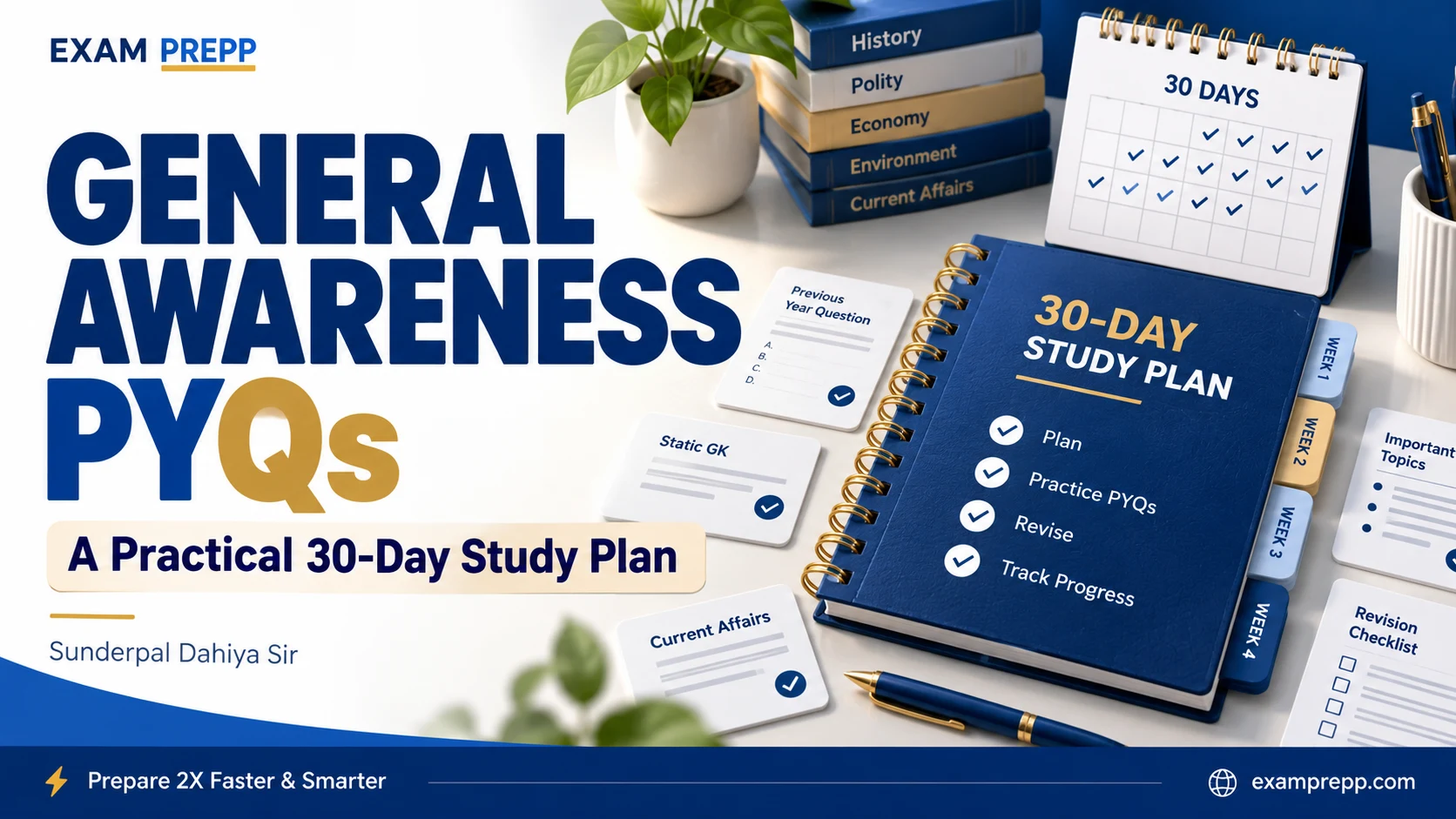
A PYQ book becomes useful when it changes what you do after a wrong answer. Start with a short diagnostic, revise one topic at a time, and retest the concepts you could not explain. This guide gives you a suggested 30-day schedule, an error-log template and a daily routine you can adapt to your available time.
हिंदी में: केवल questions पढ़कर आगे न बढ़ें। पहले खुद answer करें, फिर गलतियों का कारण लिखें और कुछ दिनों बाद दोबारा test करें।
1. Find your starting point before planning the month
Select 20 questions from topics that appear in your target exam syllabus. Attempt them without reading explanations. For every answer, mark confident, uncertain or guessed. Keep correct guesses on your revision list: a lucky answer is not evidence that the concept is secure.
Use three labels for mistakes: K for a concept you did not know, R for a fact you could not recall, and Q for misreading the question. These labels tell you what to do next. A K error needs a short concept lesson; an R error needs retrieval practice; a Q error needs slower question reading.
2. Build a topic map around your own exam
| Preparation area | What to organise | A useful learner output |
|---|---|---|
| Banking Awareness | Institutions, customer services, deposits, lending and banking processes relevant to your syllabus | A comparison sheet for similar terms |
| Financial & Economic Awareness | Financial terminology, economic concepts and the links between institutions and markets | A concept → example → related question note |
| Insurance Awareness | Core terms and the differences between products and institutions | A short glossary with an example for each term |
| Static GK | Stable facts organised by topic, rather than a single long list | Small recall sets with confusing facts grouped together |
| Current affairs | Recent developments required by your target exam | A separate dated current-affairs notebook |
This is an organising framework, not an official weightage chart. Check the current notification or syllabus for your own exam before allocating time. Give weak, relevant topics more attention; do not assign equal days merely because a book has equal-sized chapters.
3. Use a focused 45-minute daily routine
| Minutes | Task | What to record |
|---|---|---|
| 0–5 | Recall yesterday’s concepts with the book closed | What you remembered without prompts |
| 5–20 | Attempt a manageable topic-wise question set | Answer plus confidence level |
| 20–35 | Review explanations and compare the options | One reason for each important mistake |
| 35–45 | Write short recall prompts and plan your next review | Topic, weak concept and review date |
Reduce the set size if reading explanations takes longer. A smaller set reviewed properly is more useful than a larger set with unresolved errors. If you have 25 minutes, use a shorter attempt and keep the explanation review. If you have 90 minutes, add a second topic after a break.
The general idea of revisiting material after a gap and using quizzes is supported by the Institute of Education Sciences practice guide. The time split and 30-day plan here are Exam Prepp’s suggested application, not a prescribed research timetable.
4. Follow this adaptable 30-day PYQ plan
| Days | Main work | Checkpoint |
|---|---|---|
| 1–2 | Diagnostic set, syllabus mapping and topic selection | Identify three weak areas |
| 3–8 | Banking concepts and topic-wise questions | Explain your most frequent errors without the book |
| 9–14 | Financial/economic and insurance topics selected from your syllabus | Retest weak topics from days 3–8 |
| 15–20 | Static GK and remaining relevant topics | Complete a mixed set with new questions |
| 21–25 | Targeted revision of the error log | Retry uncertain and guessed answers |
| 26–28 | Mixed practice with exam-appropriate timing | Separate recall errors from time-pressure errors |
| 29–30 | Fresh diagnostic and next-month planning | Compare topic accuracy and confidence with day 1 |
Keep recent current affairs running alongside this plan. Add short review slots after a few days and again after a longer gap; adjust the interval according to recall. If a topic remains weak, extend it and shorten a stronger topic. Thirty days is a planning window, not a promise of complete exam readiness.
5. Make an error log that leads to action
| Topic / prompt | What went wrong | Next action | Review result |
|---|---|---|---|
| Deposit-account comparison | Remembered a term but confused its practical use | Create a side-by-side comparison and explain one customer example | Can explain / needs another review |
| Institution versus instrument | Matched a name without understanding its role | Write what the institution does and what the instrument represents | Retry using a new question |
| Date-sensitive banking fact | Used an older answer without checking the date | Verify the current position from the relevant official source and date the note | Record source and review date |
These are illustrative learning situations, not reproduced exam questions. Keep entries short enough to review. Copying a full explanation into another notebook can consume the time you need for practice.
6. Track understanding, not just pages finished
- Fresh-set accuracy: correct answers divided by attempted questions, tracked topic by topic.
- Confidence quality: watch confident-but-wrong answers and correct guesses.
- Explanation quality: can you give a short reason without rereading the answer?
- Retention: can you still answer after a gap, using different wording?
Use sets of similar difficulty for comparisons. Repeatedly attempting an identical set can inflate your score through answer-position memory. Change the order or use a fresh question on the same concept before declaring a topic complete.
Common habits to correct
Avoid reading the answer first, highlighting entire pages, treating every PYQ as a prediction, and revising old current affairs as if they were current facts. A previous-year question shows what was asked; it does not establish the next exam’s weightage.
7. Use the eBook as one part of a complete preparation routine
The Exam Prepp General Awareness PYQ eBook brings together 1,483 bilingual questions across 77 topics in a 587-page edition, with explanations and exam/year/shift tags where available. Use the topic index to select your next set. The first 20-page demo contains the cover, preface and index; the full book is read within the app and full PDF export is disabled.
For concept revision, use Banking Awareness study material and RBI’s basic banking education resource. Add daily current affairs separately. Test yourself through free banking quizzes. If you are moving to an interview stage, follow the 14-day bank interview preparation guide.
Frequently asked questions
Should I finish all questions before revising?
Revise while you progress. Review weak concepts after a gap and use fresh questions to check recall.
Can this 30-day plan guarantee a particular score?
No. It is a suggested planning framework. Adapt it to your baseline, syllabus, available time and current exam requirements.
Should I memorise previous-year answers?
Understand the concept, compare the options and check whether date-sensitive facts have changed. Exact answer memory alone is not enough.
Can PYQs replace current affairs?
No. Use PYQs for question patterns and concept revision, and prepare current affairs separately for your exam.
Choose your next study resource
Review the book details on Exam Prepp, or open its dedicated app listing to begin reading.
Explore the General Awareness eBookOpen the eBook in the app ↗