
If you have passed Class 12 and are asking how to begin preparing for a banking and finance career, DBF is a useful option to explore for your next step.
DBF can help you take an early, structured step towards that goal. While you continue higher education, you can begin learning how the banking and financial system works and develop a professional subject interest before graduation.
How DBF Can Help You
- Start your career learning early: explore banking through an organised qualification route.
- Support your degree with a sector focus: add banking and finance study to your academic foundation.
- Prepare for future growth: build concepts, communication and learning habits for later opportunities.
What This Can Add to Your Career
DBF can complement your degree and help you prepare more purposefully for banking. The roadmap below explains eligibility, subjects and useful next steps, with Exam Prepp classes available to guide your study.
Begin your banking journey after Class 12 with Exam Prepp
Take the next step with the DBF May 2027 course on the Exam Prepp app. Use structured classes, subject practice, revision and mentorship to turn your interest into a preparation routine. Explore the current course details and choose the support that fits your goal.
For personal guidance, contact Sunderpal Dahiya Sir through direct call or WhatsApp. Share your background and target so the discussion can focus on your study needs.
Completing Class 12 brings an important decision: what should you study next, and how can you begin preparing for your career? If you are interested in banking and finance, you can start learning the field while pursuing graduation.
One option is the Diploma in Banking & Finance (DBF) offered by the Indian Institute of Banking & Finance (IIBF). Eligible Class 12 pass-outs can take this examination, and students can prepare through DBF classes on the Exam Prepp app.
The practical approach is to combine your degree, banking knowledge, and useful workplace skills. Each serves a different purpose in your career journey.
Can You Do DBF Immediately After Class 12?
Yes. IIBF lists Class 12 or equivalent in any discipline as an eligibility route for DBF. This includes Commerce, Science, and Arts students. Graduation is not required under this route. DBF is intended for eligible non-members of IIBF; bank and financial-institution employees eligible for ordinary membership must follow IIBF’s applicable JAIIB rules instead.
Being eligible does not mean every subject will be familiar. A Science or Arts student may need extra practice in accounting, while a Commerce student may still be new to banking operations. Start with fundamentals and allow time for practice.
What Exactly Is DBF?
DBF is an IIBF qualification covering banking and finance. It helps learners move beyond everyday familiarity with bank accounts and develop a more organised understanding of the financial system.
For example, you may already know that a bank accepts deposits and provides loans. Studying banking helps you understand why customer verification matters, how lending decisions are assessed, and how financial products serve different needs.
IIBF conducts the examination and awards the qualification. Exam Prepp provides preparation classes. Joining a coaching course and registering for the IIBF examination are separate steps.
What Will You Study?
The DBF syllabus has four papers:
| Paper | Subject | A practical question the subject helps you explore |
|---|---|---|
| 1 | Indian Economy & Indian Financial System | How do banks, regulators, and financial markets fit into the economy? |
| 2 | Principles & Practices of Banking | How do banking operations and customer services work? |
| 3 | Accounting & Financial Management for Bankers | How can financial statements and calculations support decisions? |
| 4 | Retail Banking & Wealth Management | How do banking products and financial planning address customer needs? |
These questions are learning illustrations, rather than a complete syllabus checklist. Use IIBF’s current syllabus to plan your preparation.
Why Consider DBF After 12th?
1. Explore banking before committing to a career
Studying the subject can help you decide whether you enjoy finance, banking operations, accounting, or customer-oriented work. This is more useful than choosing a career only because someone describes it as secure or prestigious.
2. Give your graduation a practical direction
If you choose B.Com, BBA, BA, B.Sc., or another suitable degree, you can use DBF preparation to develop additional banking knowledge. Select your degree according to your interests, admission eligibility, and longer-term goals.
3. Build knowledge you can explain
A qualification is most useful when you understand its concepts. Practise explaining the difference between a savings account and a current account, how interest works, or why lenders examine repayment capacity. This turns study into something you can discuss confidently.
4. Establish a foundation for future learning
IIBF permits candidates who complete DBF before joining an eligible bank or financial institution to apply for conversion of their certification to JAIIB after obtaining ordinary membership and meeting its conditions. Conversion requires an application and the applicable fee; it is not automatic.
Does DBF Guarantee a Bank Job?
DBF does not guarantee employment or replace a graduation requirement in a recruitment notification. It can add banking knowledge to your profile, but recruitment depends on the employer’s eligibility criteria and selection process.
Do not assume that passing DBF makes you eligible for every bank vacancy. Read the relevant notification for educational qualifications, age, experience, and other requirements. Continue building communication, numerical ability, reasoning, and computer skills alongside your academic studies.
A Practical Roadmap After Class 12
- Choose your graduation course carefully. Consider your interests, budget, college options, and career goals.
- Check DBF eligibility and read the syllabus. Understand what you will study before paying for preparation.
- Build a sustainable routine. Begin with 60–90 minutes a day if it fits your college workload.
- Study concepts before attempting large question sets. Maintain short notes and practise calculations regularly.
- Review mistakes every week. Identify whether an error came from a weak concept, a calculation, or misreading the question.
- Register separately with IIBF. Check the current registration window, fees, and examination rules.
- Develop practical skills. Practise spreadsheets, professional emails, spoken communication, and reading financial news.
For example, a first-year college student could study one concept on weekdays, practise related MCQs, and use the weekend for revision. Increase the workload only when the routine becomes manageable.
Prepare for DBF with the Exam Prepp App
Students looking for guided preparation can explore DBF classes on the Exam Prepp app under Sunderpal Dahiya Sir. Exam Prepp describes its learning support as bilingual teaching, live and recorded classes, topic-wise notes, quizzes, mock tests, and personal mentorship.
For a beginner, a useful study sequence is: attend the lesson, revise the concept, solve questions, and discuss doubts. Before enrolling, review the selected DBF course’s current features, schedule, access validity, and price.
Explore DBF classes: View courses on the Exam Prepp app
Read more about DBF: Exam Prepp DBF guide
Remember to complete your examination registration with IIBF separately.
Frequently Asked Questions
Can Arts and Science students take DBF?
Yes. The Class 12 eligibility route covers any discipline, subject to IIBF’s other conditions.
Should I leave graduation to pursue DBF?
A more practical plan is to pursue graduation and fit DBF preparation around it. DBF is an additional qualification and does not substitute for a degree where an employer requires one.
Do I need to be working in a bank?
DBF is intended for eligible non-members, including students aspiring to enter banking. Employees eligible for ordinary membership should check the applicable JAIIB route.
Are Exam Prepp course fees and IIBF examination fees the same?
No. Preparation fees and examination registration fees are separate payments to different organisations.
How should a complete beginner start?
Read the syllabus, learn basic banking terminology, follow a structured lesson plan, and practise a small number of questions consistently.
If banking interests you, Class 12 can be the starting point for learning the profession. Choose your degree thoughtfully, build relevant skills, and use DBF preparation to develop a stronger understanding of banking and finance.
Sources checked on 9 October 2026:
- IIBF courses and eligibility
- IIBF DBF examination page
- IIBF DBF rules and syllabus, 2026
- IIBF DBF-to-JAIIB conversion and credit-transfer conditions
- Exam Prepp learning support
DBF May 2027 Classes on the Exam Prepp App
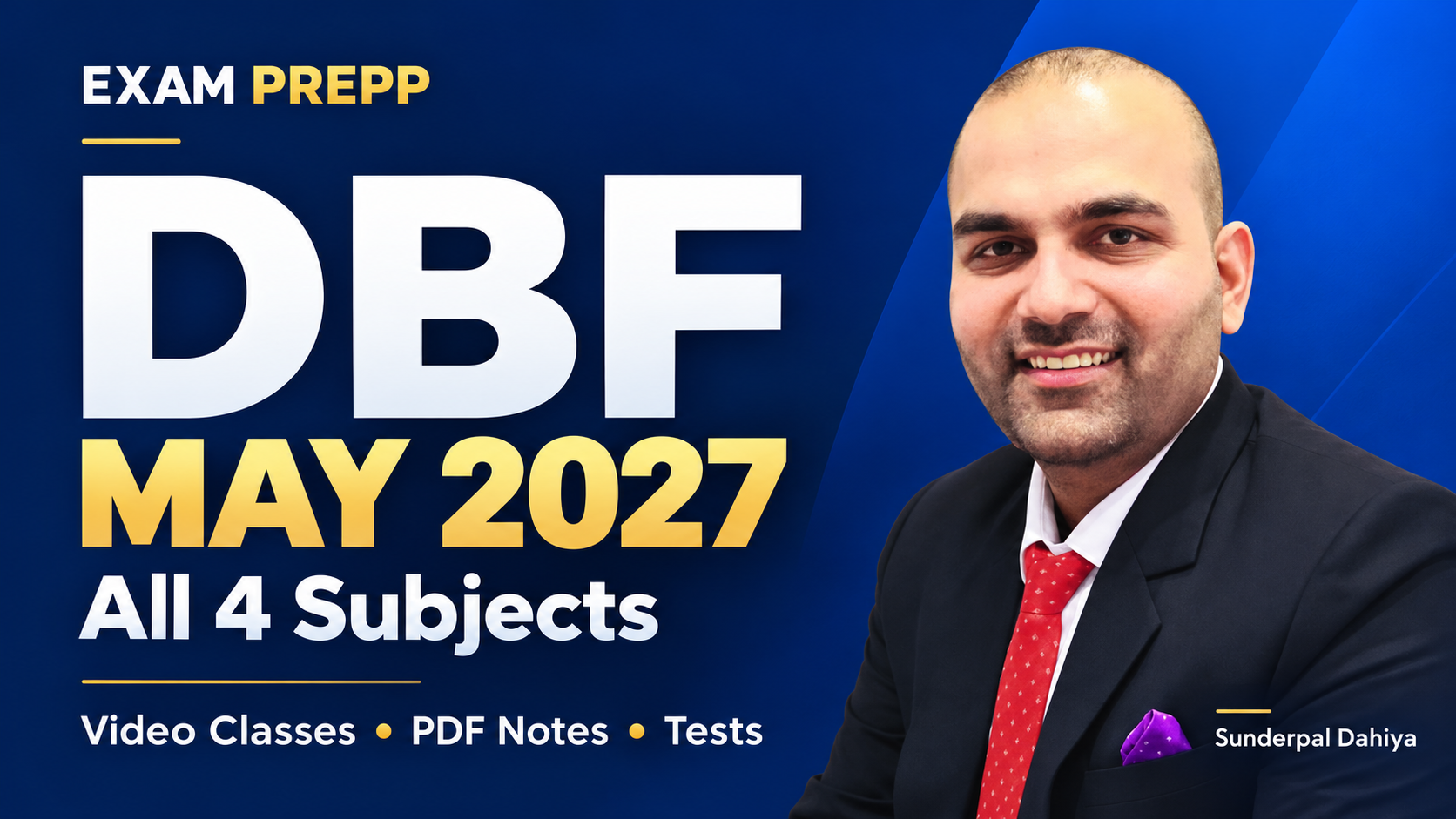
- All four DBF subjects with English content and Hinglish explanations.
- Recorded classes with live doubt sessions when required.
- PDF class notes, topic-wise quizzes and chapter-wise MCQs.
- Test series and personalised one-on-one mentorship.
Check the current schedule, fee and access plan before enrolling. IIBF exam registration is separate.