If you are an undergraduate or graduate who wants your academic qualification to connect more closely with banking opportunities, DBF is a useful option to explore for your next step.
DBF can give your degree a banking and finance dimension. You can develop subject knowledge, practise financial reasoning and prepare stronger explanations while your degree continues to build your academic foundation.
How DBF Can Help You
- Add a professional focus to your degree: study banking concepts alongside the broader knowledge of your stream.
- Use college time constructively: build understanding gradually rather than starting every banking topic after graduation.
- Leave with more to demonstrate: work towards a qualification and a set of concepts, calculations and examples you can explain.
What This Can Add to Your Career
A degree plus purposeful banking study can create a more focused learning profile than a degree alone. The advantage comes from what you learn and can demonstrate. Use the capacity plan below to make DBF an achievable part of college, placements or recruitment preparation.
Add banking knowledge to your graduation with Exam Prepp
Take the next step with the DBF May 2027 course on the Exam Prepp app. Use structured classes, subject practice, revision and mentorship to turn your interest into a preparation routine. Explore the current course details and choose the support that fits your goal.
For personal guidance, contact Sunderpal Dahiya Sir through direct call or WhatsApp. Share your background and target so the discussion can focus on your study needs.
In This Article
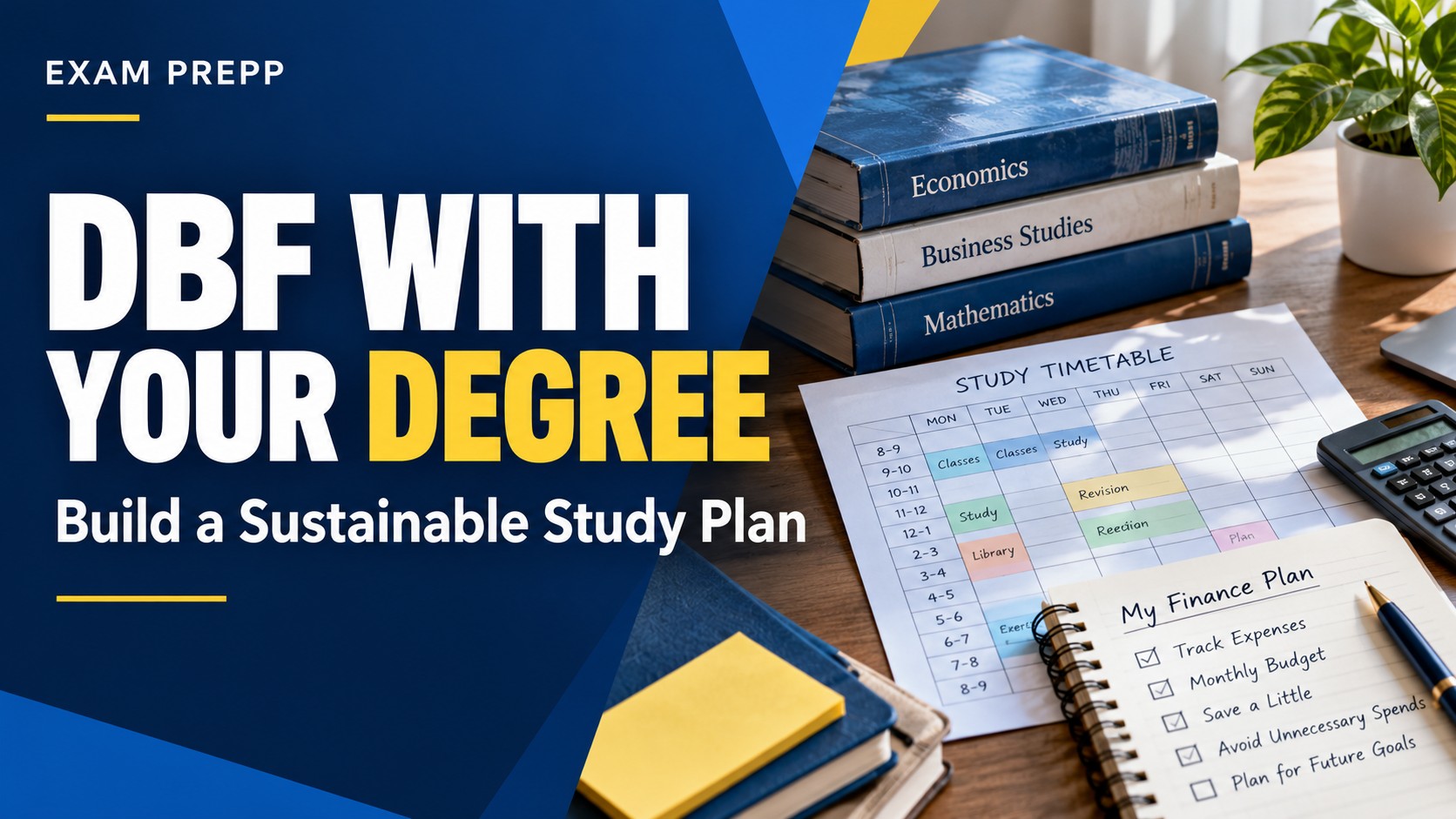
Start with a Capacity Audit
- List fixed college, work, travel and family commitments.
- Mark approaching university examinations and recruitment dates.
- Identify reliable study slots rather than every theoretically free hour.
- Reserve time for revision and mistakes, not just new classes.
For seven days, record the study sessions you actually finish. If you planned six and completed three, build the next week around three dependable sessions. You can increase the load after consistency improves.
Choose a Routine That Fits Your Stage
| Stage | Suggested starting pattern | Main risk to manage |
|---|---|---|
| Early undergraduate | Three concept sessions and one review session weekly | Ignoring degree foundations while trying to finish too much |
| Final-year student | Short sessions around projects and placement work | Losing time needed for graduation and applications |
| Graduate preparing for recruitment | Dedicated DBF blocks alongside protected mock-test blocks | Replacing speed practice with subject reading |
| Graduate with work or family commitments | Recorded lessons in small blocks plus a weekly doubt list | Accumulating unwatched classes without practice |
These patterns are planning examples rather than course completion estimates. The right pace depends on your starting knowledge and the amount of practice needed.
Build a Degree-to-DBF Connection
Use a topic you already know to make the new material concrete. A commerce student can revisit a financial statement; a science student can practise careful use of units and assumptions; a humanities student can develop clear explanations of institutions and policy.
One useful college exercise
Take a fictional student club budget. Separate money collected, amounts still receivable and expenses due next month. Prepare a short note explaining why the cash balance alone cannot answer whether every obligation can be paid.
This is an original learning exercise, not professional financial advice. Its purpose is to move from familiar college situations to disciplined financial thinking.
Use a Weekly Completion Scorecard
| Measure | Useful evidence | What to change if weak |
|---|---|---|
| Recall | Explain one concept without notes | Reduce new lessons and revisit the basics |
| Practice | Solve and review a small question set | Identify why errors occurred |
| Application | Write one short fictional example | Check assumptions and missing facts |
| Consistency | Complete planned sessions for two weeks | Shorten sessions or move them to reliable times |
Avoid judging yourself only by hours studied. Four focused sessions with reviewed mistakes can be more useful than a large number of unfinished videos.
Decide When to Reduce the Load
Reduce new DBF learning during university examinations, important project submissions or an approaching recruitment stage. Keep a small recall session if possible so that restarting is easier. A temporary reduction is a planning decision, not a failure.
Before taking on additional paid preparation, check examination eligibility and course access. Students who start employment in a bank or financial institution during preparation should recheck the appropriate IIBF route promptly.
Leave Graduation with Demonstrable Progress
- An accurately stated qualification status on your CV.
- A set of concept summaries written in your own words.
- Reviewed practice records and a clear list of remaining weaknesses.
- Two or three fictional examples you can explain in an interview.
- A realistic plan for the next recruitment or learning stage.
Use Exam Prepp mentorship to review the plan when your college timetable changes. Ask for a sequence you can complete rather than collecting more resources than you can use.
Frequently Asked Questions
Can a graduate from any stream consider DBF?
An eligible candidate can consider it; the study plan should reflect their prior knowledge and employment status.
Should a final-year student study DBF at full pace?
Only if it fits degree, project and recruitment commitments. Start with an honest capacity audit.
Do college marks become less important after DBF?
No. Maintain your degree performance and meet the requirements of your target opportunities.
What should I track weekly?
Recall, reviewed practice, an application exercise and consistency.
What happens if I join a bank before finishing?
Recheck IIBF membership and DBF-to-JAIIB rules before registering for another DBF attempt.
Prepare for DBF May 2027 with Exam Prepp
Bring structure to your preparation with the DBF May 2027 course on the Exam Prepp app. Explore support for all four papers through recorded classes, PDFs, quizzes, chapter-wise MCQs, test series and mentorship, with live doubt sessions when required. Check the current listing for fees, schedule, access and inclusions; coaching enrolment is separate from IIBF examination registration.
 Explore Courses on the AppAsk on WhatsAppJoin the DBF Telegram Group
Why Choose Exam Prepp for Structured Preparation?
- Concept explanations followed by questions and revision.
- Chapter-wise practice to identify weak areas rather than only watch classes.
- Personal mentorship through direct call or WhatsApp message and discussion support.
- A study routine adapted to your graduation, work or recruitment commitments.
About Mentor & Author: Sunderpal Dahiya Sir
Sunderpal Dahiya Sir has more than 10 years of teaching experience. Use mentorship to clarify difficult concepts, review errors and plan realistic preparation. For course guidance, call or WhatsApp 8800528912.
Teaching note: Study content is in English, with explanations in Hinglish to support understanding. संकल्पना समझें, अपने शब्दों में समझाएँ और प्रश्नों का अभ्यास करें।
Follow the Exam Prepp YouTube channel for learning updates.
Related Reading for Your Next Step
- DBF After 12th: A 30-Day Starter Plan Before You Commit
- Missed Bank Exam Selection or Waiting for Results? A Productive DBF Decision Plan
- Build Banking and Finance Skills with DBF: A Six-Task Learning Portfolio
- DBF Exam and Preparation Guide
References and learning note · checked 9 October 2026: IIBF DBF rules and syllabus; IIBF examination information. Consult the applicable official rules for eligibility and registration. Study plans, comparisons and fictional exercises in this article are educational guidance rather than official syllabus-overlap percentages or guaranteed outcomes.