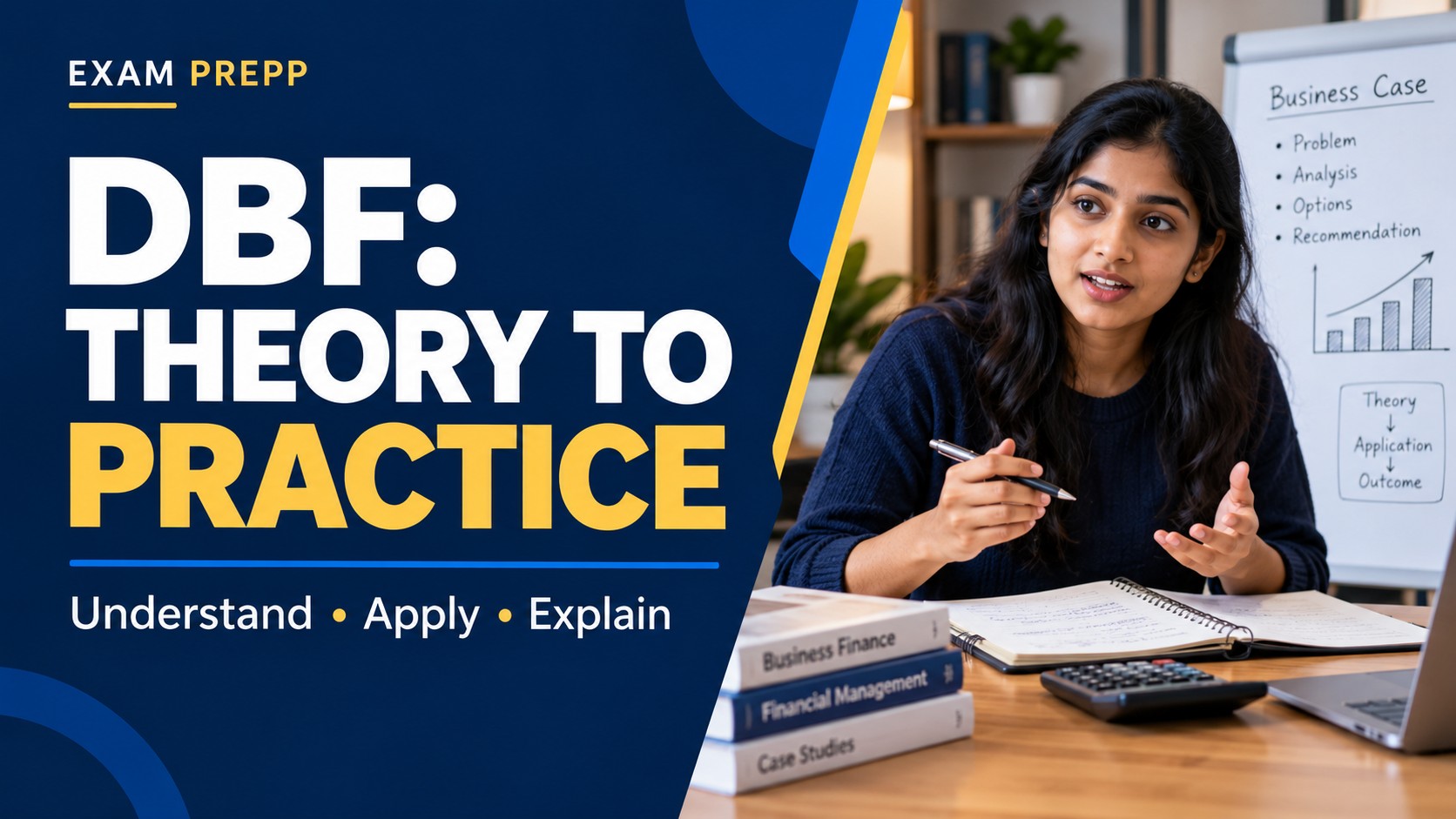
If you understand definitions but want to use banking concepts in practical situations, DBF is a useful option to explore for your next step.
DBF can help you build a theoretical foundation and connect it with financial reasoning. By practising original cases alongside the lessons, you can learn to ask better questions, identify missing information and explain a decision more clearly.
How DBF Can Help You
- Make learning usable: connect a concept with an example rather than memorising it in isolation.
- Build sound judgment: distinguish known facts, assumptions and details that need checking.
- Prepare stronger explanations: use reviewed exercises as evidence of what you understand.
What This Can Add to Your Career
Practical understanding can support interviews and the transition to supervised workplace learning. The exercises below show how to turn DBF study into thoughtful preparation that you can explain.
Learn concepts and practise applying them with Exam Prepp
Take the next step with the DBF May 2027 course on the Exam Prepp app. Use structured classes, subject practice, revision and mentorship to turn your interest into a preparation routine. Explore the current course details and choose the support that fits your goal.
For personal guidance, contact Sunderpal Dahiya Sir through direct call or WhatsApp. Share your background and target so the discussion can focus on your study needs.
In This Article
- How this qualification can help you
- What this adds to your career
- Use a Concept-to-Case Learning Cycle
- Case 1: Profit and the Timing of Cash
- Case 2: Explain a Service to a Beginner
- Case 3: An Incomplete Request
- Turn Cases into Examination and Interview Practice
- Build a Small Learning Portfolio
- Frequently Asked Questions
Use a Concept-to-Case Learning Cycle
- Choose one concept and explain it accurately.
- Create a small fictional situation involving it.
- Identify the facts you need and the assumptions you are making.
- Work through the reasoning or calculation.
- Explain what the result means and what remains uncertain.
This is an educational method, not an employer’s decision procedure. Keep the case simple enough to understand. Adding many details can obscure the concept you are trying to practise.
Case 1: Profit and the Timing of Cash
Imagine a business with recorded sales of ₹1 lakh for a month, of which ₹40,000 is expected to be collected later. Suppose the example includes ₹70,000 in cash expenses due during the same month. Those limited facts suggest a possible timing gap; they do not give the complete financial position.
| Item in the fictional case | Amount | What to ask next |
|---|---|---|
| Sales recorded | ₹1,00,000 | When are collections expected? |
| Immediate collection | ₹60,000 | Are there other available funds? |
| Cash expenses due | ₹70,000 | Can timing or funding meet the difference? |
The immediate collection is ₹10,000 below the stated expenses. Check whether opening cash, other receipts or timing changes alter the picture. This exercise shows why a conclusion should follow from clearly identified facts and assumptions.
Case 2: Explain a Service to a Beginner
A fictional customer says, “I want something convenient, but I do not understand the conditions.” Practise asking what convenience means to them and what they need the service for. Then explain the relevant information in simple terms.
- State the purpose.
- Describe how it is used.
- Explain costs, conditions or limitations that need checking.
- Ask the customer to confirm their understanding.
Use invented situations. Do not present a study exercise as individual advice or claim it qualifies you to recommend a product without the appropriate information and authority.
Case 3: An Incomplete Request
A decision practice prompt
You are asked to proceed with a task, but an important piece of information is missing. What would you do before making a decision?
A useful response identifies the gap, explains why it matters and seeks clarification through the appropriate route. It does not fill the gap with an assumption just to finish quickly. Practise adapting the response when the requester is impatient.
This case builds the connection between knowledge and judgement. In actual work, follow the employer’s current instructions and authority limits.
Turn Cases into Examination and Interview Practice
After solving a case, ask how the same concept could appear as an objective question, a calculation or a spoken explanation. Change one detail and review whether the answer changes.
| Practice format | What to produce | What to check |
|---|---|---|
| Objective | A question with plausible alternative answers. | Each option has a clear reason for being correct or incorrect. |
| Calculation | A short worked example. | Inputs, units and arithmetic are explicit. |
| Spoken answer | A concise explanation. | It answers the question and states relevant limits. |
These exercises are original practice material, not recalled IIBF questions or predictions. They help you test whether you understand the reasoning.
Build a Small Learning Portfolio
Keep a few carefully reviewed exercises rather than a large folder of copied examples. For each, include the concept, fictional facts, reasoning, conclusion and limitations. Add a short reflection explaining what you initially misunderstood.
Revisit the exercises later. If you can still explain them, the learning is becoming usable. Combine this work with structured lessons, the prescribed material and appropriate question practice. The practical value comes from accurate understanding and application, not from calling every exercise “real-world experience.”
Frequently Asked Questions
Does a practical insight mean actual bank work experience?
No. Fictional learning cases and employment experience should be described separately.
Can beginners create their own cases?
Yes. Use small, clearly labelled examples and verify the reasoning.
Should I use real customer information?
Use invented data for study exercises and respect confidentiality.
How do I know an example is useful?
It should clarify one concept, make assumptions explicit and support a reasoned explanation.
Learn DBF with Exam Prepp
Bring structure to your preparation with the DBF May 2027 course on the Exam Prepp app. Explore support for all four papers through recorded classes, PDFs, quizzes, chapter-wise MCQs, test series and mentorship, with live doubt sessions when required. Course content is in English, with teaching explanations in Hinglish. Check the current course listing for access, schedule, fees and inclusions before enrolling.
 Explore DBF ClassesAsk on WhatsAppJoin the DBF Telegram Group
Guidance from Sunderpal Dahiya Sir
Study with guidance from Sunderpal Dahiya Sir, with more than 10 years of teaching experience. Use mentorship to identify weak concepts, review mistakes and plan a manageable study routine. For course guidance, contact Exam Prepp by call or WhatsApp at 8800528912.
For learning updates, visit the Exam Prepp YouTube channel.
Continue Your DBF Learning
- How DBF Builds Job Readiness for Your First Banking Role
- DBF Cost and Study Options: Plan an Affordable Banking Qualification
- Is DBF Equivalent to JAIIB? Recognition, Eligibility and Conversion Explained
- DBF Exam: Preparation and Course Guide
- Pursuing DBF Along with Graduation
Official references · checked 9 October 2026: IIBF DBF rules and syllabus; DBF examination information; DBF-to-JAIIB conversion and credit transfer. Use the latest official rules for applications and eligibility. Examples and study exercises in this article are illustrative.